FREE WORLDWIDE TRACKED SHIPPING

Do You Need a Permit to Replace a Roof in California?
 By Alex Carter
California roof replacement permit rules vary by city, while state licensing and energy requirements can also apply
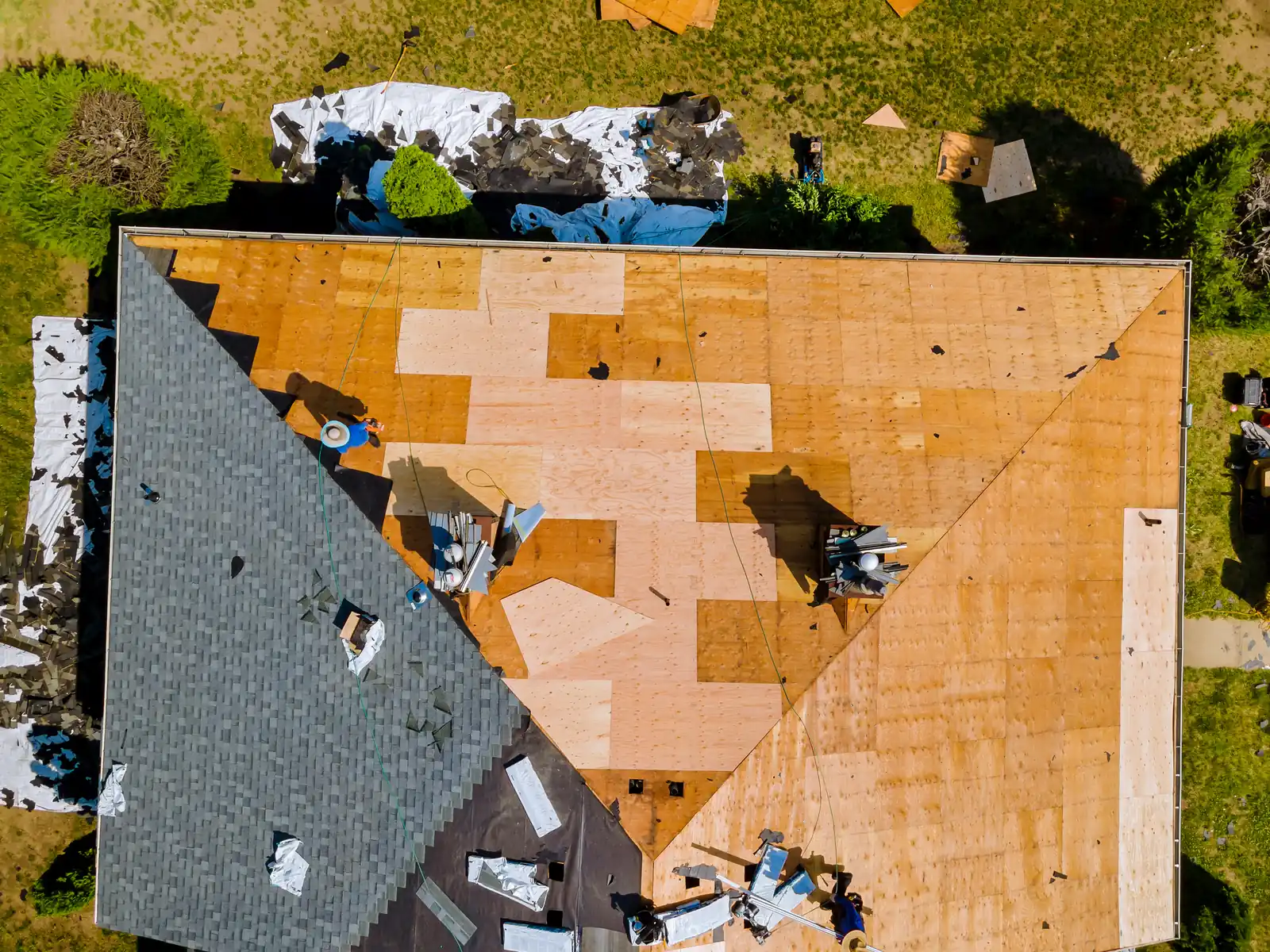
One roofer’s bid says “permit included.” Another says “no permit needed.” Do you need a permit to replace a roof in California? Your city or county decides, and San José and San Diego draw that line far apart. The roofer’s license and the energy code are state rules, though. Even San Diego, which skips the permit when the roof structure stays untouched, notes that a roof replacement may trigger the state energy code. Layers and fire ratings, the fourth rule, vary by city again.
San José counts the share of roof being redone; San Diego asks whether the structure underneath changes.
Your city decides which reroofs need a permit
San José draws its line at a quarter of the roof. Reroof 25 percent of it or more within 12 months, and the city wants a building permit. Work on less than 25 percent is generally exempt only when it does not involve the underlying framing and meets the city’s 12-month limit. Most projects can get one online, with a Permit Card listing the required inspections, where a city inspector checks for code compliance.
San Diego’s Information Bulletin 123 starts from the other end. Renewing a roof covering needs no building permit as long as the existing roof structure, roof diaphragm included, stays unaltered. It does need one when:
- the reroof means altering or replacing framing or decking (houses, duplexes and townhouses may swap damaged decking in kind without one, within a quarter of the roof surface);
- wood shakes, asphalt shingles or wood shingles are replaced by roofing that weighs over six pounds per square foot;
- old spaced “skip” sheathing comes out for new plywood or OSB decking;
- the property is in a historic district or holds a designated historical resource.
Solar panels that come off for the work bring their own permits: electrical in San Diego, electrical or mechanical in San José.
Find your building department’s reroof page and fee schedule, and ask where its line falls.
The roofer on the permit should hold a C-39 license
San José recommends a licensed contractor as the permit applicant. In California, roofing is license class C-39. CSLB, which licenses contractors statewide, describes the work as keeping water out of a structure by sealing, waterproofing and weatherproofing its surfaces.
On a roofer’s record, look hard at workers’ compensation. CSLB lets a licensee with no employees file an exemption, but not one holding C-39. Each active C-39 license needs workers’ comp coverage or a valid certificate of self-insurance, whether the roofer has employees or not. CSLB’s guide to hiring a licensed contractor notes that this shows up when you check the license status. CSLB adds that coverage must be continuous: a lapse leads to suspension, and work done while suspended counts as unlicensed.
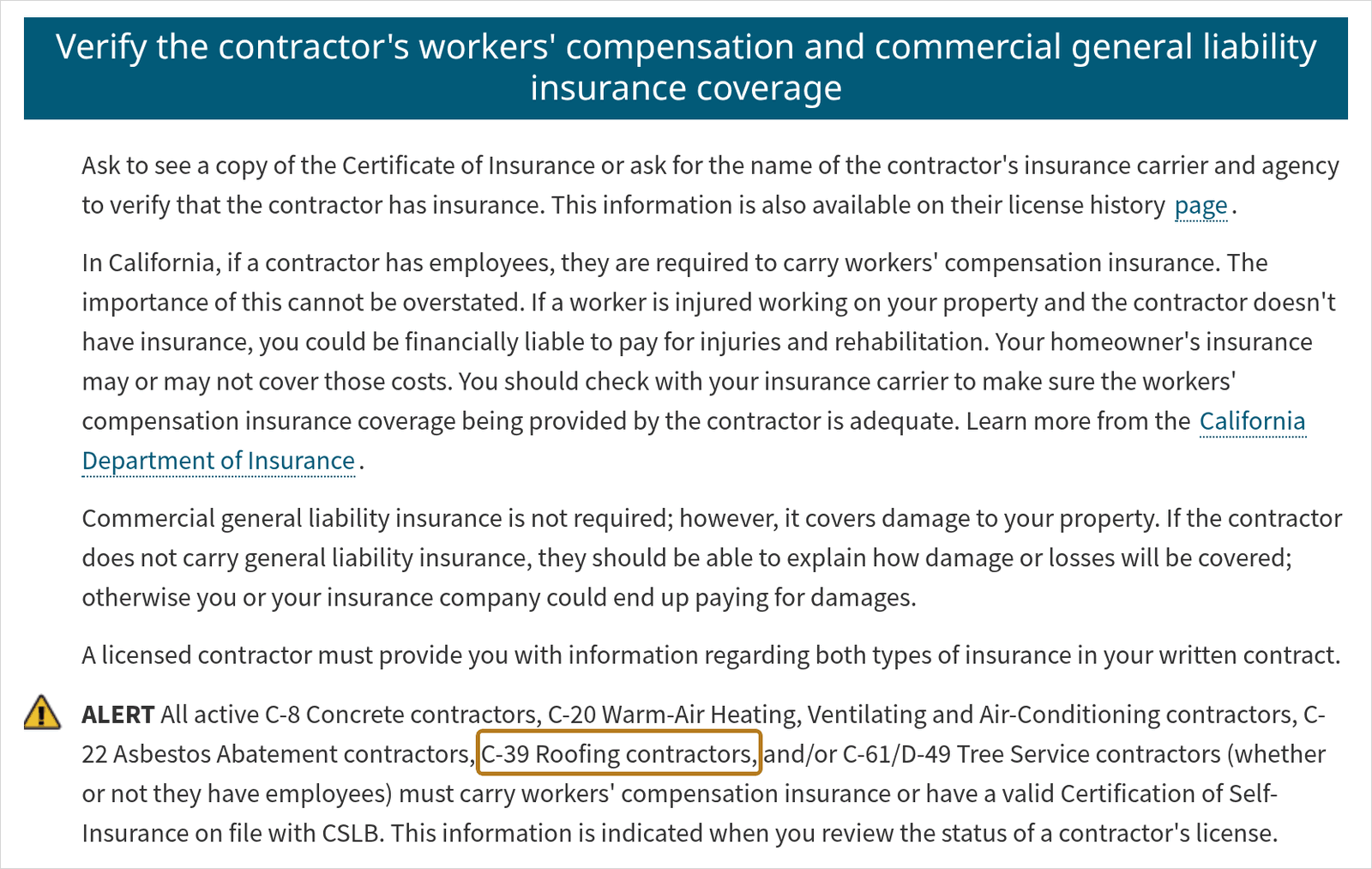
CSLB’s hiring guide names roofing, class C-39, as one of five classes that need workers’ comp even without employees.
Every bid and contract from a roofer has to carry the license number. Still, CSLB cautions that a visible number is no guarantee the license is valid. To check a roofer’s license, run the number through CSLB’s Check a License tool, or the business or contractor name if it’s missing. Then confirm the record shows C-39 and an active status.
Unsure how that workers’ comp line should read? Legit Pages explains the three documents CSLB accepts for it, a policy, self-insurance or an exemption, and why a roofing license can’t rely on the last one. It also keeps a summary of California’s reroof rules, citing a source for every rule and showing when they were last checked.
Replacing more than half the roof brings in the energy code
The California Energy Commission ties the code edition to the permit date. Applications filed from January 1, 2026, onward fall under the 2025 edition (Title 24, Part 6). Its compliance manual for single-family homes counts reroofing as an alteration, not a repair, even when wood shakes give way to asphalt shingles.
For single-family homes, the cool roof rule starts when more than half the roof area is replaced, and a new layer over the old surface counts, too. On a steep roof, meaning a pitch of 2:12 or more, it covers climate zone 4 and zones 8 through 15. There, roofing needs an aged solar reflectance of at least 0.20 and a thermal emittance of at least 0.75, or a solar reflectance index of at least 16. Low-slope roofs have separate reflectance and insulation requirements, with different climate-zone coverage and exceptions.
A steep roof can skip the product rule if the home has one of these:
- R-38 or better ceiling insulation;
- a radiant barrier in the attic that meets the code;
- R-2 continuous insulation or better on either side of the roof deck;
- in six of the zones, an attic with no ducts in it.
The Energy Commission’s EZ Building Climate Zone Search Tool shows which of the 16 zones an address falls in. Where a ZIP code spans more than one, the commission notes, local jurisdictions may assign a single zone to all of it. Confirm yours with the building department.
Layers and fire ratings decide what can go over the old roof
Laying new shingles over old ones saves a tear-off, but both cities limit it. San José allows two composition roof covers at most and permits nothing over wood shakes except metal tiles listed for that purpose. Once all the coverings together weigh more than seven pounds per square foot, it wants the roof’s supporting structure analyzed by an engineer. It also sets minimum slopes, from 2:12 for asphalt shingles to 4:12 for concrete tile.
San Diego goes further. If a roof already carries two layers of asphalt shingles, or of built-up roofing, every layer has to come off, down to the deck, before re-covering. Nothing new may go over wood shingles or shakes, either.
Fire ratings split the same way. San José sets a Class C minimum, which it says California law requires for new roofs and reroofs alike. San Diego wants Class A on any replacement, alteration or repair, and for the entire roof once over a quarter of it is redone within 12 months. Where the city maps a very high fire hazard, buildings originally constructed from August 27, 2009, onward face added fire protection rules.
Whatever applies, have the bid spell it out: tear-off or overlay, and the new covering’s fire class.
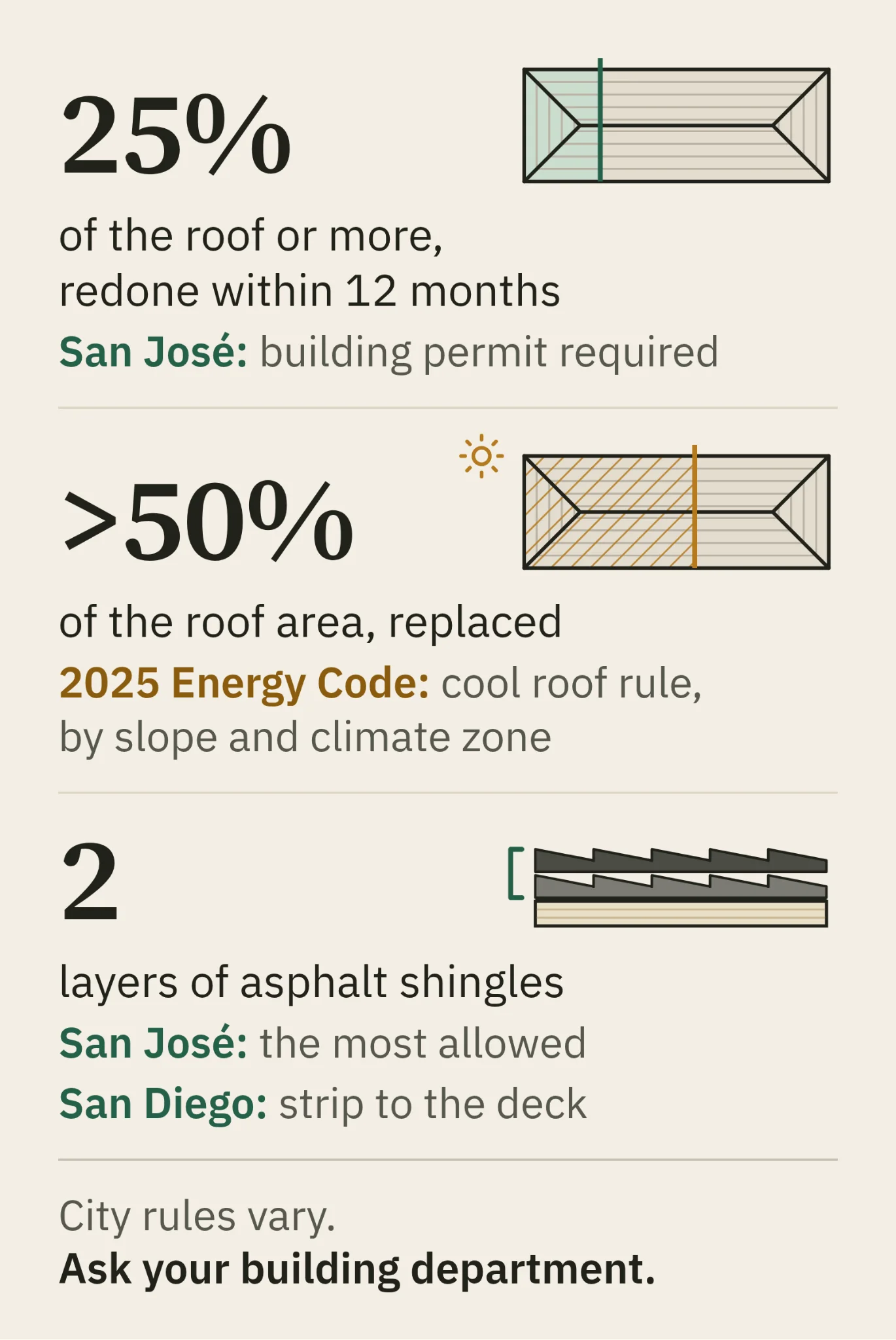
Three numbers behind a California reroof: two from city rules, one from the state energy code.
Replacing the roof yourself still runs through the permit office
Do you need a permit to replace your roof yourself? Doing the work yourself changes who needs a license, not the permit rules. Section 7044 of the state Business and Professions Code spares an owner building or improving a structure on their own property from the contractor license law. Two conditions apply: none of the work is meant or offered for sale, and the owner does all of it personally, or through employees paid only wages.
Sign as the owner-builder on the permit application, CSLB says, and you take on full responsibility for every phase of the project. You pull the permits, and the work must pass code and building inspections. San José adds an owner-builder acknowledgement form for owners who apply.
Bring in anyone who isn’t a licensed subcontractor, and CSLB warns you may count as an employer. The duties that follow include tax withholding, workers’ comp and unemployment contributions. If your own workers get hurt, or an unlicensed or uninsured subcontractor does, CSLB says you may end up paying through your homeowner’s insurance or defending a lawsuit. Suppliers or subcontractors who aren’t paid on time can file a mechanics lien against the property.
Six questions to settle before the tear-off
Work through these before you sign:
|
Question |
Who answers it |
What to get in writing |
|
Does this reroof need a permit? |
Your local building department |
The permit, with its inspection list |
|
Is the roofer licensed for roofing? |
CSLB’s license lookup: active status, C-39 class |
The bid and contract, each showing the license number |
|
Is workers’ comp on file? |
The same CSLB record; a C-39 license can’t be exempt |
A copy of the insurance certificate |
|
Does the cool roof rule apply? |
The 2025 Energy Code, by share of roof replaced, slope and climate zone |
The product’s rating, or the exception that applies |
|
Can the new roof go over the old one? |
Local reroof rules on layers and weight |
Tear-off or overlay, plus the covering’s fire class |
|
How big can the deposit be? |
CSLB: capped by law at the lower of $1,000 and 10 percent of the job’s price, unless a blanket bond is on file |
A payment schedule in the contract |
The city answers for the permit, CSLB for the roofer and the energy code for the material. Get every answer on paper before the tear-off.
Frequently asked questions
What happens if you replace a roof without a permit?
The new roof misses the city inspection that a permit brings. San José’s reroof page adds a note: “Insurance companies may deny claims related to unpermitted work.”
Can the roofer pull the permit for you?
In San José, that’s what the city recommends: a licensed contractor as the applicant. Its page adds that the person who signs the application answers, and may be liable, for everything done under the permit. Sign it yourself as an owner-builder, and that responsibility is yours.
Check with your city. In San José the limit is two composition covers. In San Diego, a roof that already has two layers of asphalt shingles, or of built-up roofing, gets a full tear-off.





 Blankets and Throws
 Home Accessories
 Furniture
 Rugs
 Cushions

 Kitchen
 Cutlery and Dinnerware
 Drinkware
 Table Mats and Coasters
 Dining Accessories
 Tablecloths and Napkins

 Decorative Items
 Vases and Planters
 Wall Decor

 Bathroom Accessories
 Bathroom Storage
 Bath and Shower Mats
 Towels