FREE WORLDWIDE TRACKED SHIPPING
A Bedside Rug Can Fix an Unfinished Bedroom — If You Place It Properly
 By Alex Carter
Choose a bedside rug by where your feet land and how the room moves, not by a generic size chart. Compare four practical layouts for real bedrooms.
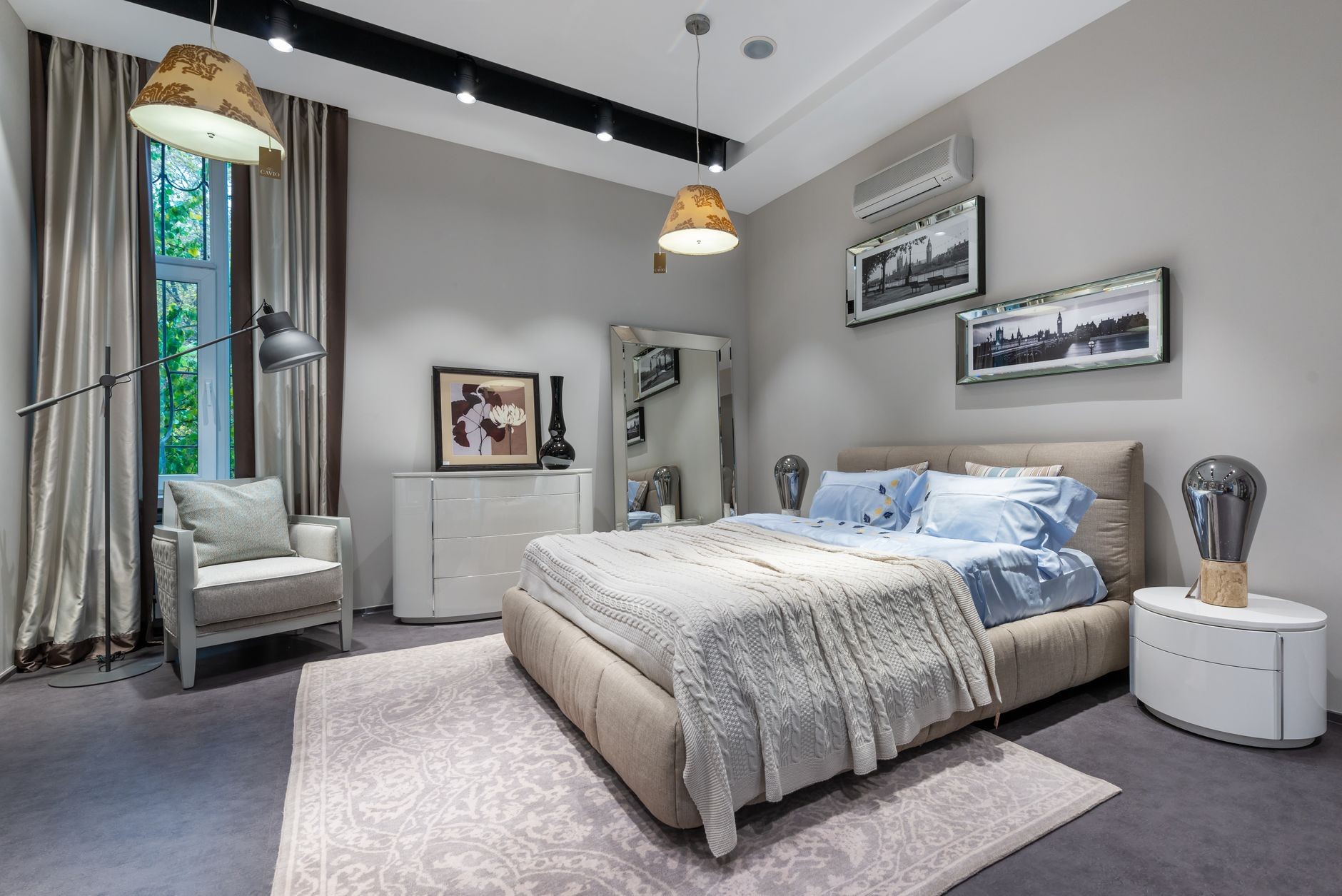
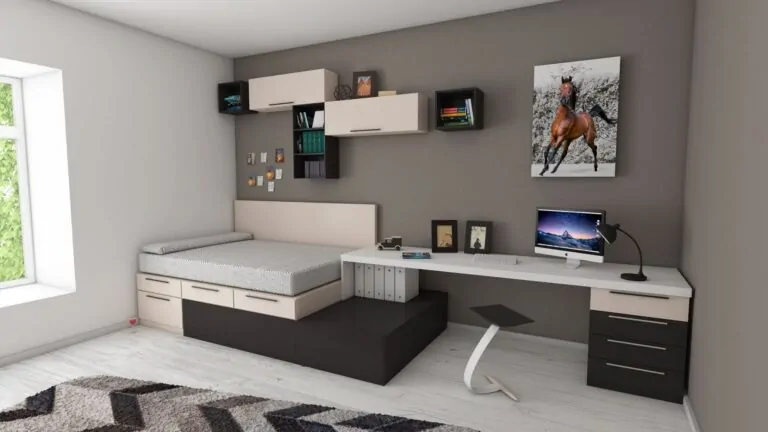
Photo by Max Vakhtbovych via Pexels.
A bedside rug should begin where your feet naturally meet the floor and extend far enough to make that landing feel deliberate. It does not have to sit centered in the room, and it certainly does not have to disappear almost entirely under the bed.
That is the liberating thing about bedside rug placement: the bed is the anchor, but your daily movement is the test. A modest runner placed intelligently can do more for a narrow bedroom than an undersized area rug stranded beneath a king bed.
Pick the layout before you pick the pattern
Most rug mistakes begin in the opposite order. A beautiful rug comes home, then the room is asked to accommodate its dimensions. Reverse the process: identify the useful floor area, choose the layout, tape it out, and only then look at color and pattern.
| Your room constraint | Best starting layout | Useful starting proportion | What to avoid |
|---|---|---|---|
| Spacious, symmetrical room | One large rug under the bed and nightstands | Visible border on both sides and beyond the foot | A rug that stops at the bed frame |
| Standard room, moderate budget | Rug under the lower two-thirds of the bed | Enough side exposure for both feet and a generous foot-end border | Starting so low that the rug looks detached |
| Narrow room or bed against a wall | One runner along the open side | Longer than the bedside walking zone; narrow enough to keep door clearance | Forcing visual symmetry the room does not have |
| Rental or two independent sides | Two matching bedside rugs | Align with each other and the usable length beside the bed | Tiny mats that resemble bath rugs |
| Very small room with a clear foot zone | One rug across the foot of the bed | Wider than the bed, with the long edge parallel to the footboard | A short rug that has no relationship to the bed width |
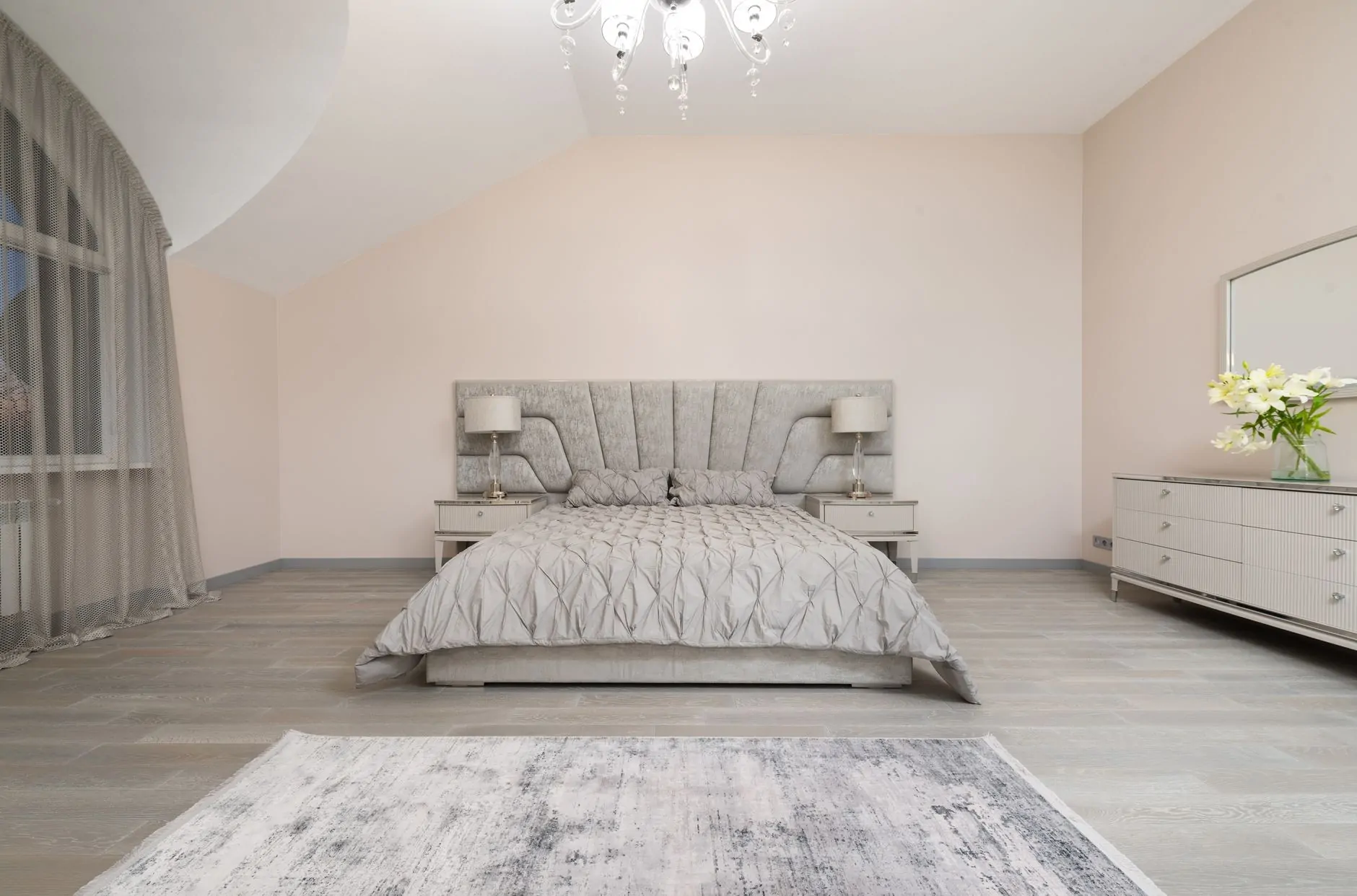
Start with the place your feet land
Stand beside the bed where you normally get up. Mark that point with painter’s tape, then take two ordinary steps toward the doorway. That strip of movement is the minimum useful zone for a bedside rug.
The rug should not require a precise morning dismount. If half your foot lands on wood and half on textile, it is too narrow or too close to the bed. If the rug extends into a door swing or bunches where you turn, it is too large for that route—even if a standard size chart says otherwise.
Large bedroom-rug guides often recommend extending an area rug roughly 18 to 24 inches beyond the bed. That is a helpful visual benchmark, not a commandment. Homes & Gardens similarly frames rug size around furniture layout and movement, which is the more useful rule for irregular rooms.
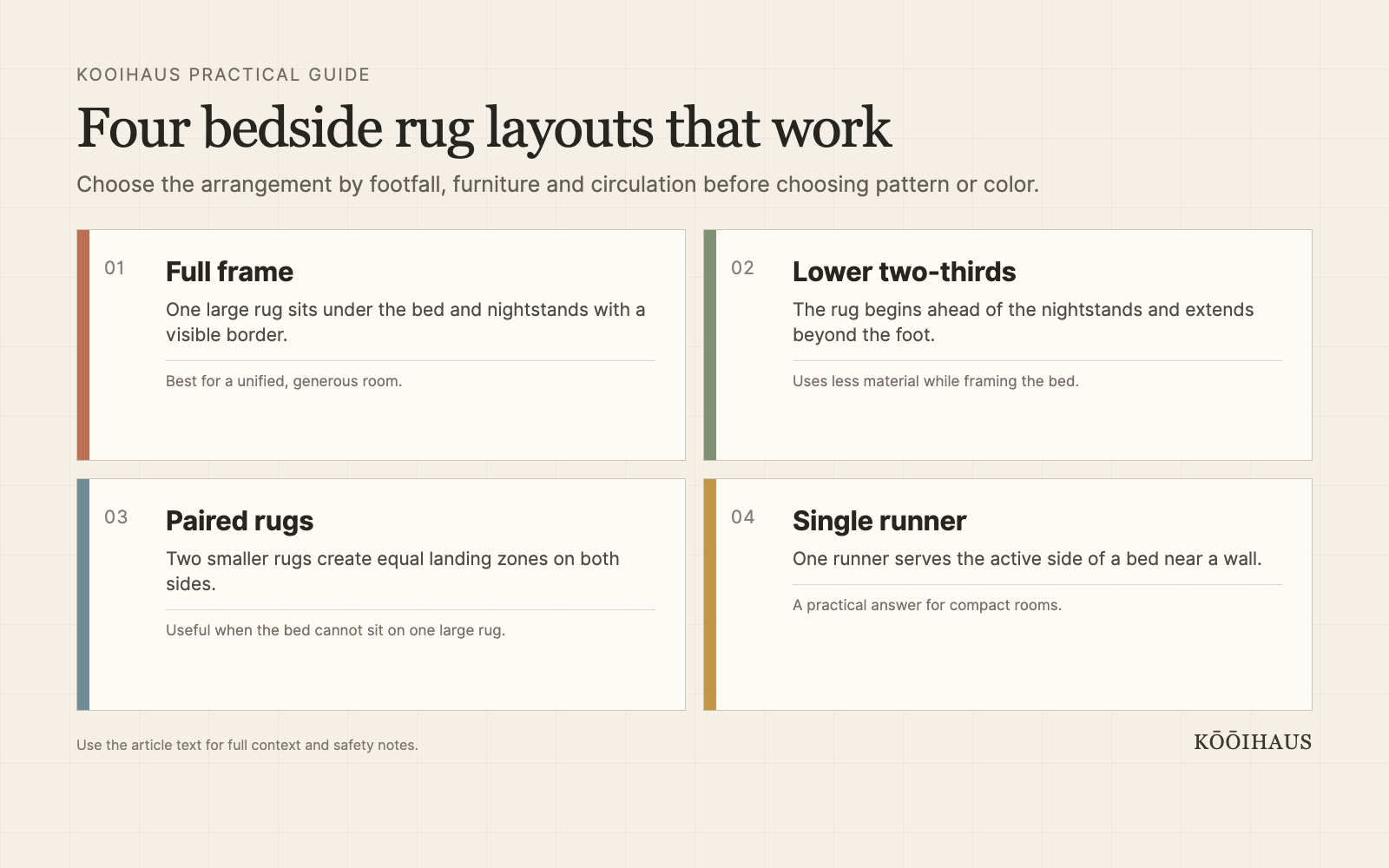
Four bedside rug layouts that actually work
1. The full-frame rug
This is the most formal option: the bed and nightstands all sit on one large rug, with an even textile border visible around the composition. It makes the sleep zone read as a single piece of architecture.
It is worth the floor coverage when the room is spacious and the bed floats comfortably away from the walls. It is often unnecessary in a small bedroom, where most of the expensive rug disappears under furniture and the remaining border can pinch circulation.
Worth it for: large primary bedrooms, cold floors, and strongly symmetrical schemes.
Skip it when: a door, radiator, wardrobe, or tight walkway breaks the border on one side.
2. The lower-two-thirds rug
Here the rug begins in front of the nightstands and runs under the lower portion of the bed, extending beyond the foot. Current designer guidance collected by Ideal Home describes this as a flexible, more economical alternative to putting every piece of bedside furniture on the rug.
The key is connection. Push the rug far enough under the bed that the overlap is unmistakable. A rug touching only the final few inches of the frame looks accidental; one carrying a substantial portion of the bed feels anchored.
This is the safest all-purpose layout because it gives both sleepers a soft landing, adds pattern at the visible foot of the bed, and avoids wobbling nightstands.
3. Two bedside rugs
Paired rugs are not a compromise if they are treated as a pair. Match their dimensions and align their top and bottom edges. The pair can be identical or share the same weave and palette, but they need a visible relationship.
Long, low bedside rugs feel more intentional than small rectangles. Leave a narrow strip of floor between the bed and rug rather than tucking an unstable edge beneath the frame. That separation makes the objects easier to clean and prevents the bed from pinning down only one edge.
This layout also lets you change a worn rug without moving the bed. In a rental, that practical advantage may matter more than textbook symmetry.
4. One runner on the active side
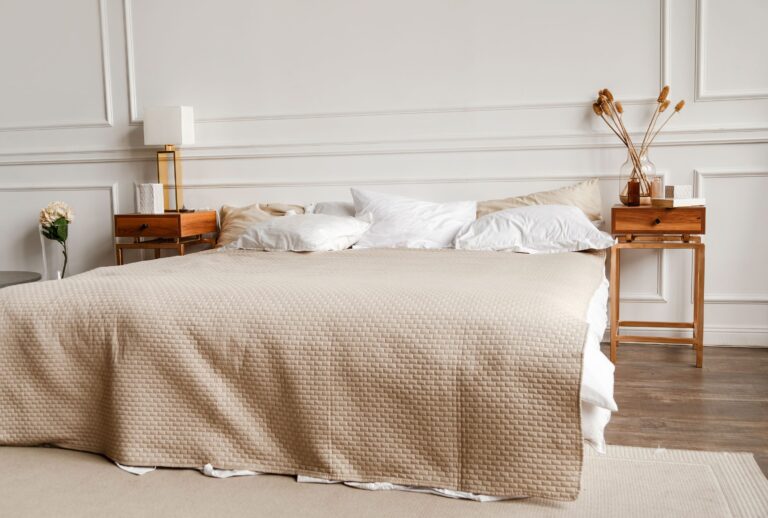
Not every bedroom deserves symmetry. If one side of the bed sits against a wall, a runner on the open side acknowledges the actual plan instead of pretending the bed is centered.
Run its long edge parallel with the bed. Begin near the nightstand or pillow zone and finish around the foot area, depending on the route to the door. A runner that continues far beyond the bed starts to read as a hallway rug; one that ends around the useful landing zone belongs to the bed.
This is our favorite small-bedroom solution. It delivers comfort and visual length without sacrificing the little exposed floor the room has.
How to measure without memorizing a size chart
Standard rug sizes are useful only after you understand your own clearances. Measure these five things:
- The bed frame’s true width and length, not just the mattress label.
- The clear distance to each wall or wardrobe. Keep the rug from visually squeezing one side.
- Door and drawer swings. Include under-bed drawers, wardrobe doors, and room doors.
- The distance from the bed to your first turn. That defines the useful walking zone.
- The amount of rug you want visible. Tape the outline and photograph it from the doorway.
The tape test is more reliable than imagination. Live with the taped outline for one morning. Open every door, walk the route, and look at the room from the threshold. If the proportions feel timid in tape, the real rug will not become more convincing.
Rugs Direct’s placement guide makes the same central point from another direction: small rugs under large beds are a common mistake because size and placement determine whether the bed feels grounded.
Choose material for bare feet and real cleaning
The most luxurious rug is not necessarily the deepest pile.
Low wool pile offers warmth, resilience, and a tailored outline. It is a strong choice when the bedroom needs quiet texture rather than fluff.
Flatweave cotton is lighter and often easier to move, but it needs a reliable rug pad. Thin corners can curl, and an unsecured runner beside a bed is a safety problem, not a charming imperfection.
Washable synthetic rugs suit pets, children, and allergy-conscious cleaning routines. Inspect the edge finish: a thick bound edge can be uncomfortable exactly where a bare foot lands.
Long pile or shag creates softness but catches dust and makes bedside furniture harder to position. Use it as a fully exposed runner or pair, not half-trapped under a frame where it is difficult to vacuum.
For a rug that eventually needs more than routine vacuuming, our fine-rug deep-cleaning guide explains why fiber, construction, wicking, and controlled drying should guide the method.
A rug pad is non-negotiable on a smooth floor. It should be cut slightly smaller than the rug so it remains invisible and should be rated for the flooring beneath it.
Corrections for awkward bedrooms
If the bed is off-center, do not center the rug on the room. Center it on the bed or on the active walking zone, depending on the chosen layout.
If the nightstands are mismatched, keep them off the rug and let a lower-two-thirds layout create order below. If one side has much less clearance, use a single runner rather than two rugs of different widths.
If the room already contains several patterns, choose a rug with texture and low contrast. If the bedroom is visually flat, a restrained geometric border can sharpen the bed’s footprint without becoming the loudest object in the room. Our Japandi bedroom ideas offer a useful palette for that quieter approach.
For a very compact plan, see our small minimalist bedroom guide. The same principle applies: every object should earn the floor area it occupies.
The Kooihaus verdict
Worth stealing: tape out a lower-two-thirds rug first. It is the most forgiving layout for a conventional bedroom and gives you the most visible textile for the money.
Better for a genuinely small room: one properly scaled runner on the active side. Honest asymmetry looks more composed than a too-small attempt at grandeur.
Skip: the decorative postage stamp beside the bed. If it catches only one foot, slides on the floor, or has no visual relationship to the bed, it is not finishing the room—it is adding another loose object.
A rug should make the bedroom feel calmer before you notice its motif. Place it according to movement, give it enough visual authority, and the room will stop looking as if the final layer was forgotten.
Frequently asked questions
Should you have one bedside rug or two?
Use two when both sides of the bed have similar clearance and both sleepers need a landing. Use one runner when only one side is active or the room is intentionally asymmetric. One confident choice is better than forced balance.
Should a bedside rug go under the nightstand?
Only when a large rug is designed to carry the entire bed composition. Small bedside rugs and runners generally work better clear of the nightstand, which keeps the furniture level and the rug easier to clean.
Which direction should a bedside runner face?
Place its long edge parallel with the bed. That orientation follows the walking path and visually lengthens the sleep zone.
Can you put bedside rugs over carpet?
Yes, for color or texture, but use a pad designed specifically for rug-on-carpet applications. Check that the edges do not curl or create a trip point.
How do you stop a bedside rug from slipping?
Use a floor-compatible non-slip rug pad cut just inside the rug’s perimeter. Avoid relying on furniture to pin down only one edge, which can create ripples.









 Blankets and Throws
 Home Accessories
 Furniture
 Rugs
Rugs Cushions
 Kitchen
 Cutlery and Dinnerware
 Drinkware
 Table Mats and Coasters
 Dining Accessories
 Tablecloths and Napkins
 Decorative Items
 Vases and Planters
 Wall Decor
 Bathroom Accessories
 Bathroom Storage
 Bath and Shower Mats
 Towels