FREE WORLDWIDE TRACKED SHIPPING

Emma Chamberlain x West Elm: What Works in a Small Space
 By Alex Carter
The best Emma Chamberlain x West Elm pieces use shallow depth and hidden storage, while the larger seating needs a more generous floor plan

Image: West Elm.
Launch facts, prices, dimensions, and availability were checked against West Elm’s US pages on October 23, 2026, and may change.
A small room does not need every piece of furniture to look small. It needs each piece to spend its inches well. That is the useful test inside the Emma Chamberlain West Elm collection, a 78-piece launch filled with curved wood, chrome, lacquer, patterned textiles, and objects based on Chamberlain’s personal symbols.
The collection’s best small-space pieces share a less photogenic advantage: they are shallow. A side table is 13 inches deep. A storage cabinet is 14 inches deep. A desk fits its work surface and drawer into 36 inches of width. Those measurements matter more than the playful colors because they preserve the strip of floor people actually walk through.
The weaker choices reverse that equation. They add a strong silhouette or another surface without solving storage, circulation, or seating. In a generous room, that can be fun. In a small home, it is where personality becomes congestion.
The collection launched in March, not October
West Elm launched the collaboration on March 30, 2026. That date appears across the brand’s launch campaign and contemporary coverage from Vogue, Architectural Digest, House Beautiful, and Apartment Therapy. The launch assortment contained 78 pieces spanning furniture and decor, and the official West Elm collection remained available online when checked in October.
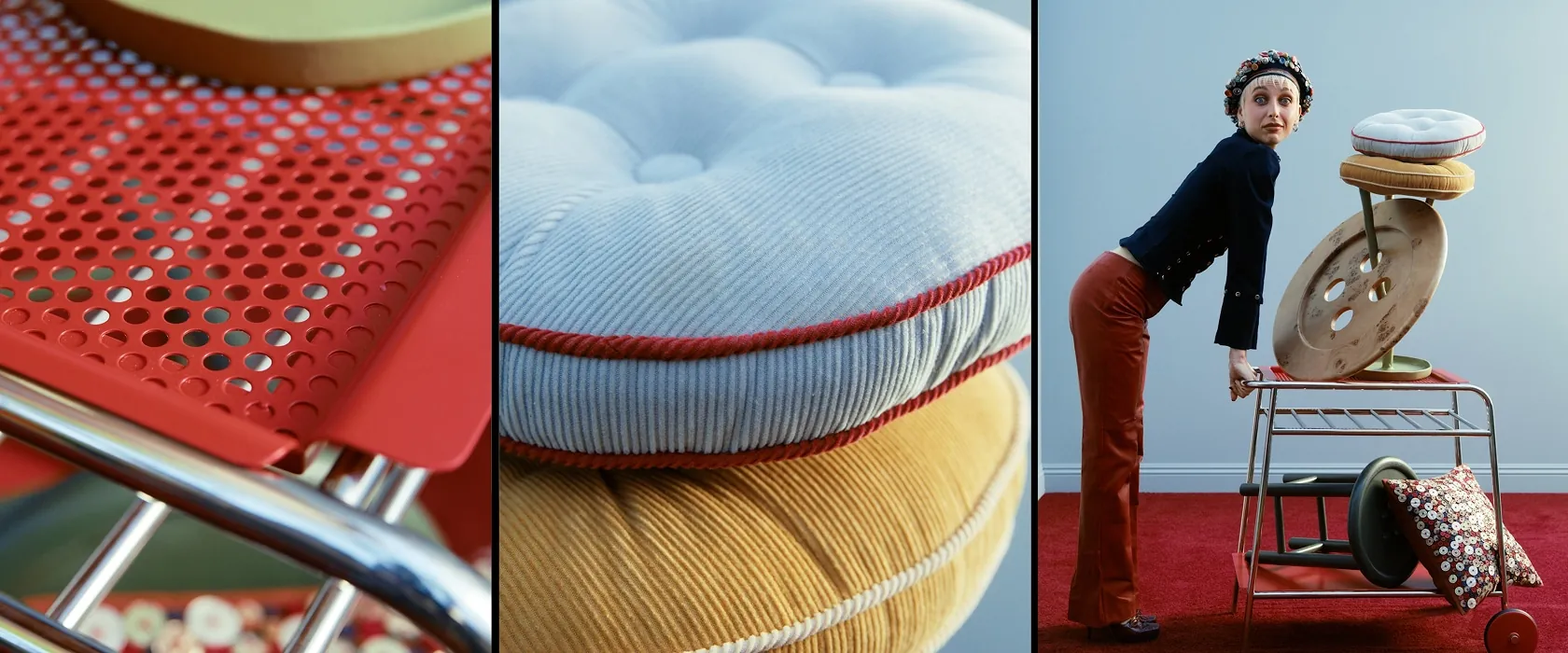
Chamberlain worked with West Elm’s in-house design team on her first comprehensive interiors collection. The palette moves between dark walnut, avocado lacquer, red metal, blue upholstery, chrome, and warm patterned textiles. Buttons, birds, fruit, and house forms connect many of the accessories to her tattoos and collecting habits.
That personal language explains the collection. It does not exempt the furniture from measurement. West Elm repeatedly describes the line as multifunctional and suited to contemporary living, so the fairest review is to ask where that function is real.
The small-space discovery is depth
Furniture listings usually lead with width because that number is easy to compare. Depth often decides whether a piece works. A cabinet that projects 20 inches into a narrow hall may be unusable even if it is only 24 inches wide. A 36-inch desk can still crowd a bedroom if it is too deep for the passage between the bed and wall.
Three Emma Chamberlain pieces stay close to the wall. The Demi-Lune Side Table measures 26 inches wide by 13 inches deep. The Lacquer Wrapped Storage Cabinet measures 25.8 inches wide by 14 inches deep. The Mini Desk is 36 inches wide and includes a built-in drawer. These are not invisible objects, but their footprints respect a room that has to do more than one job.
This is the collection’s non-interchangeable lesson: playful furniture can be spatially disciplined. Color does not make a piece impractical. Wasted depth does.
The four pieces that work hardest
1. The Lacquer Wrapped Storage Cabinet
The avocado cabinet is the clearest small-space winner. West Elm lists two doors, an adjustable interior shelf, and a rear media cutout inside a footprint that is 25.8 inches wide and 14 inches deep. It can hold games, media, charging equipment, or entryway supplies without borrowing the depth of a full-size credenza.
At $549 on the official page, it is not casual storage. The lacquer finish is also visually assertive, so it works best where the room needs one color anchor. Use it in an entry, office nook, or compact living room. Skip it if the green finish would force you to replace several things you already own.
If the storage problem is bigger than one cabinet, start with our guide to entryway storage that does not look like storage. A freestanding piece cannot correct a layout that needs hooks, shoe space, seating, and closed storage at once.

2. The 36-inch Mini Desk
The Mini Desk uses a walnut and mahogany veneer top over a polished stainless-steel frame, with a drawer on metal glides. West Elm explicitly positions it for an office nook in a small space. The $499 price buys a finished piece rather than a folding workstation, and the open frame keeps the floor visible.
The drawer is useful but modest. This is a laptop desk, writing table, or bedroom work surface, not storage for files, a printer, and office supplies. Measure chair pullback and screen distance before deciding that 36 inches of desk width means the whole workstation will fit.
3. The Demi-Lune Side Table
A half-moon table uses the wall or sofa edge as part of its geometry. At 26 inches wide and 13 inches deep, this version can create a landing surface without projecting a full circle into the walkway. Two open shelves hold books or baskets, and the solid acacia construction gives it enough visual presence to stand alone.
The open shelves also expose everything. If visual clutter is the problem, the table will display it instead of containing it. Treat it as a side table with disciplined storage, not as a substitute for a cabinet.
4. The 12-inch nightstand and storage pillar
The narrow lacquer pieces use vertical space where a conventional nightstand or entry cabinet may not fit. A 12-inch width can rescue a tight bedside gap or the dead strip beside a door. This is a better small-space strategy than shrinking every item in the room, which often creates more separate objects and more visual noise.
The trade-off is stability and capacity. Tall narrow furniture should be anchored as directed, and a tiny top may not hold a lamp, water, phone, and book at the same time. Decide which two jobs matter most.
The playful pieces that need restraint
The button side table, pigeon ceramics, apple basket, and stitched pillows are the easiest pieces to recognize. They are also the easiest to overuse. One personal symbol can make a room feel specific. Five symbols spread across every surface can turn the room into campaign merchandise.
The button side table is only 14 inches wide, but a compact footprint is not the same as useful storage. It gives you a top, not a drawer or shelf. Choose it when the room already has storage and needs one deliberately odd object. Skip it when every available inch must work twice.
The same rule applies to the sculptural console and larger mirrors. A shallow console can be practical in a hall, but an open form may not solve the keys, mail, shoes, and charging cables that accumulate there. The object has to meet the mess you actually have.

What to skip in a small home
Start with the largest modular sofa configurations. The collection offers several lengths and combinations, which helps, but a modular label does not make a sofa small. Measure the full configuration, the ottoman position, door swing, and the path through the room. If the sofa requires you to sidestep around it, choose fewer modules or a simpler seat.
Be cautious with the chair-and-ottoman sets for the same reason. An ottoman is useful only when it can sit in front of the chair without blocking the route, or tuck away when not in use. Otherwise it becomes an extra object that must be moved every day.
Finally, skip a matched room. The collection intentionally mixes decades and motifs, so buying every coordinated piece works against its own premise. Chamberlain’s approach is accumulation over time. A room assembled in one checkout can copy the palette without gaining the personality.
Quick decision table
| Piece | Why it works | Reason to skip |
|---|---|---|
| Lacquer Storage Cabinet | 14-inch depth, closed storage, adjustable shelf | Bold finish may dominate a quiet room |
| Mini Desk | 36-inch width and built-in drawer | Limited storage for a full office setup |
| Demi-Lune Side Table | 13-inch depth and wall-hugging shape | Open shelves expose clutter |
| 12-inch narrow pieces | Use difficult gaps and vertical space | Small tops and limited capacity |
| Button Side Table | Compact and visually specific | No concealed storage or second function |
| Large modular sofa | Configuration can adapt to a generous room | Modules still require real circulation space |
How to make the collection feel collected
Choose one foundational piece and one symbol. The foundation might be the dark wood desk or storage cabinet. The symbol might be a pigeon pitcher, button pillow, or apple basket. Put them with furniture you already own and repeat one color elsewhere in the room. That creates a relationship without a set.
Keep the large furniture quieter when the accessory is playful. Keep the accessories quieter when the furniture is bright lacquer or strongly curved. Our guide to a collected, not cluttered living room explains why variation needs a repeated material or color to hold together.
Also protect empty space. A room does not become unfinished because one corner remains open. In fact, the circulation guidance in our small living room mistakes article is a useful counterweight to any collection page that shows furniture from edge to edge.

Frequently asked questions
When did the Emma Chamberlain West Elm collection launch?
The collection launched on March 30, 2026. It was not an early October launch, although many items remained available in October.
How many pieces were in the launch collection?
West Elm’s parent company and launch coverage described a 78-piece assortment spanning furniture and decor. Retail pages may show a different number because they separate sizes, finishes, variants, or later availability.
Which pieces are best for a small space?
The strongest options are the 13-inch-deep Demi-Lune Side Table, the 14-inch-deep storage cabinet, the 36-inch Mini Desk, and the narrow 12-inch nightstand or storage pillar. Each uses limited depth or an awkward gap efficiently.
Does the collection include hidden storage?
Yes. The lacquer cabinet has two doors and an adjustable shelf, while the Mini Desk has a built-in drawer. Other pieces provide open shelves or display surfaces rather than concealed storage, so check the exact product details.
Is the collection limited edition?
West Elm describes the collaboration as limited edition. Availability varies by product, finish, and delivery location, so the official listing is the current source.
The verdict
The Emma Chamberlain West Elm collection works in a small home when it uses depth carefully and gives one object more than one job. The storage cabinet, Mini Desk, Demi-Lune table, and narrow vertical pieces pass that test. The larger seating and purely decorative tables need more caution. Choose the inches that improve the room, then leave enough empty floor for the room to work.





 Blankets and Throws
 Home Accessories
 Furniture
 Rugs
 Cushions

 Kitchen
 Cutlery and Dinnerware
 Drinkware
 Table Mats and Coasters
 Dining Accessories
 Tablecloths and Napkins

 Decorative Items
 Vases and Planters
 Wall Decor

 Bathroom Accessories
 Bathroom Storage
 Bath and Shower Mats
 Towels