FREE WORLDWIDE TRACKED SHIPPING
Dark Bedroom Ideas: Moody, Luxurious, Never Cave-Like
 By Alex Carter
A dark bedroom reads luxurious or cave-like depending on four things — LRV, layered light, finish, and contrast. Here is how to get all four right.
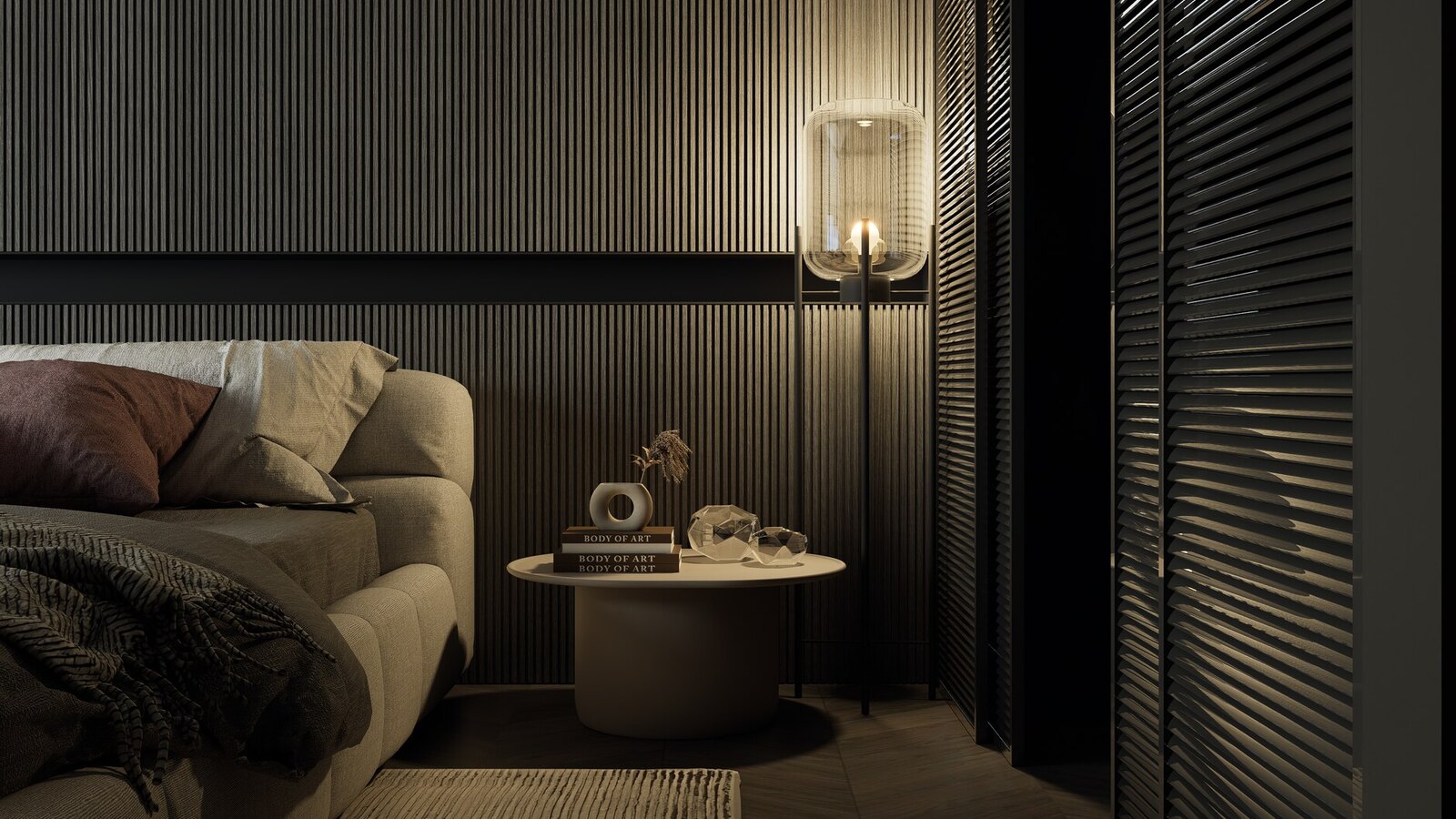
Photo: The Ghazi / Pexels
A dark paint chip carries one useful specification: its light reflectance value. It does not carry the size of the window, position of the lamps, sheen on the wall, color of the floor, or texture of the bedding.
Those missing variables decide whether a dark bedroom feels dimensional or disappears into one undifferentiated surface.
Darkness is not what makes the room luxurious. Controlled visibility does. The eye should still be able to read the bed, wall planes, wood grain, fabric, and edges after sunset.
This is not another list of branded paint colors. The transferable system is light, LRV, finish, contrast, and material.
The four-part dark-bedroom system
| Element | What it controls | Common failure |
|---|---|---|
| LRV | How much visible light the paint reflects | Choosing from the chip without testing the room |
| Lighting | Which surfaces remain visible | One bright ceiling fixture surrounded by shadow |
| Finish | How light spreads or creates highlights | Glossy walls with distracting hot spots |
| Contrast | Whether forms separate from the background | Dark walls, bed, floor, and curtains collapsing together |
Fix all four and a near-black bedroom can feel calm and precise. Ignore them and even a medium charcoal can feel flat.
Use LRV as a comparison, not a verdict
Light reflectance value runs from 0 to 100. Lower values reflect less visible light; higher values reflect more. Sherwin-Williams’ guide to room orientation correctly treats LRV as one factor that changes with natural and artificial light.
LRV does not tell you whether a color is warm, cool, glossy, flattering, or suitable for a bedroom. It also does not measure the size of the window or the output and placement of the lamps.
Use it to compare candidates within a color family.
If two blue-black samples look similar on a screen but one has an LRV of 8 and the other 18, the second will return more light to the room. That difference may be modest beside a large south-facing window and substantial in a bedroom with one north-facing window.
There is no universal luxury threshold. A useful testing sequence is:
- Start with a deep midtone if daylight is limited.
- Test the lowest-LRV candidate only after planning the evening lighting.
- Compare samples on two walls, because the window-facing wall and side wall will not behave alike.
- Judge the color after sunset as seriously as at noon.
A dark bedroom is used most when daylight is absent. The evening test is the real test.
Light the walls, not only the floor
A single central fixture can make a dark room technically bright while leaving its architecture unreadable. The floor receives light, the upper walls disappear, and the ceiling becomes a lid.
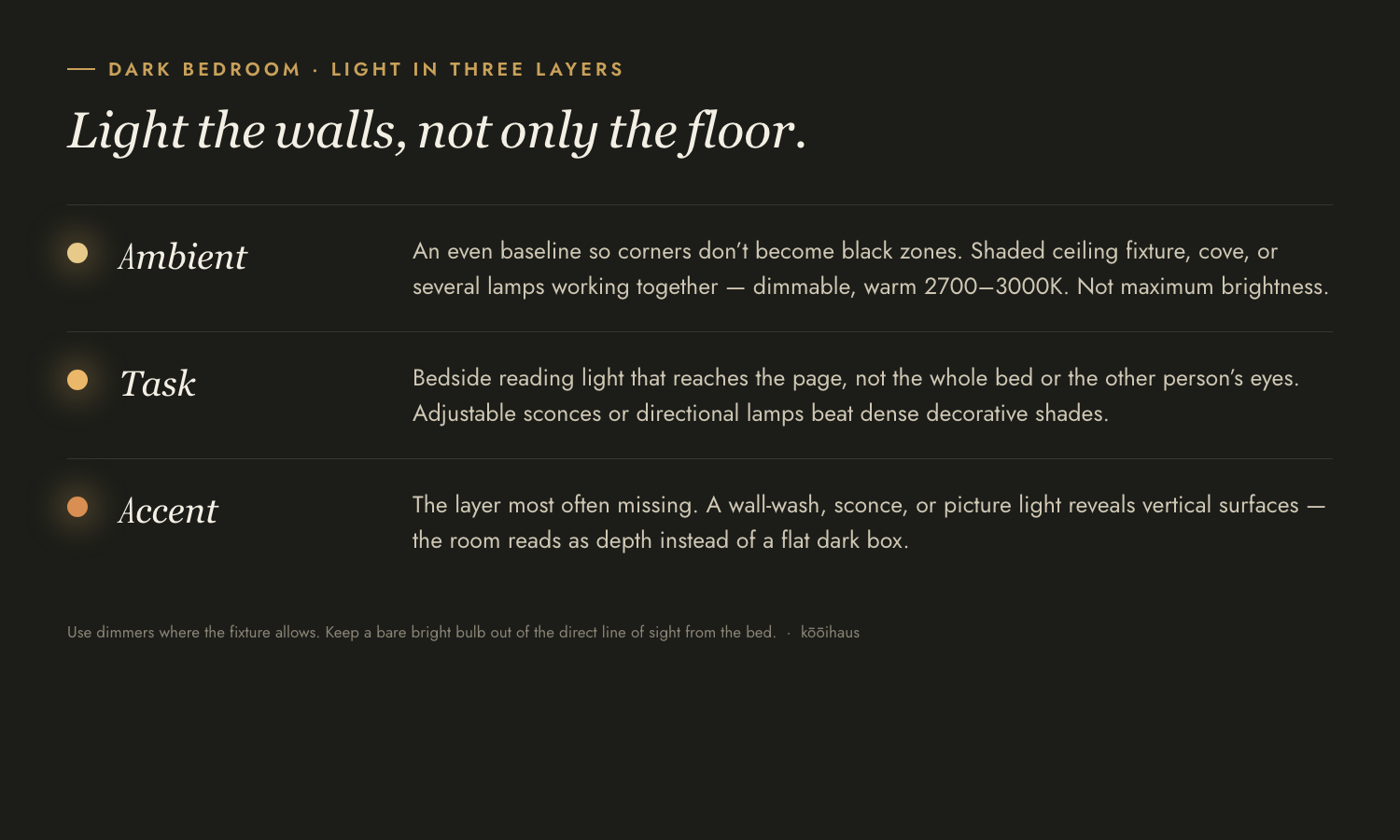
Layered lighting solves a different problem at each height:
Ambient light
This provides the room’s general visibility. It can come from a shaded ceiling fixture, indirect cove, pendant, or several lamps working together.
The goal is not maximum brightness. It is an even baseline that prevents the corners from becoming unrelated black zones.
Bedside task light
A reading light should reach the page without flooding the whole bed or shining directly into the other person’s eyes. Adjustable sconces and directional lamps do this more precisely than decorative lamps with dense shades.
Vertical or accent light
This is the layer most often missing. A wall-washing lamp, shaded floor lamp, picture light, or sconce reveals vertical surfaces. The room begins to show depth because the eye can read one wall as nearer and another as farther away.
The Illuminating Engineering Society describes layered and indirect lighting as a way to balance different types of light and make important surfaces legible. In a dark bedroom, that is the difference between atmosphere and lost geometry.
Use dimmers wherever the fixture and lamp allow them. The room needs one scene for dressing or cleaning and another for winding down.
Keep the light warm, but not amber everywhere
Warm white light generally sits around 2700–3000K, according to ENERGY STAR’s lighting guidance. That range suits most bedrooms because it softens dark paint and supports a lower-energy evening atmosphere.
Do not solve every dark room by making every lamp extremely warm. Against brown, burgundy, olive, or warm black, very amber light can flatten color distinctions and make white bedding look yellow.
A practical combination is:
- Warm ambient and bedside light
- Good color rendering for clothing, art, and skin
- One controlled directional source on a wall or artwork
- No exposed bright bulb in the direct line of sight from the bed
The room should glow from surfaces, not glare from hardware.
Choose the finish surface by surface
Paint finish changes how light returns to the eye.
Benjamin Moore’s finish guide describes eggshell as a low-sheen finish that reflects more light than matte while retaining a restrained appearance. That makes it useful, but not automatically correct for every dark wall.
| Surface | Useful starting finish | Reason |
|---|---|---|
| Main walls | Matte or low-sheen eggshell | Preserves color depth without hard reflections |
| Uneven walls | Matte | Hides surface irregularity more effectively |
| High-touch wall area | Washable eggshell | Easier maintenance with a soft glow |
| Trim and doors | Satin or semi-gloss | Separates edges and tolerates handling |
| Ceiling | Flat or matte | Avoids overhead glare and visible roller marks |
| Built-ins | Satin | Makes joinery readable against quieter walls |
A glossy dark wall does not distribute daylight evenly. It creates bright reflections around windows and lamps, then drops quickly back into darkness. That can work on lacquered cabinetry or a small architectural element. Across imperfect drywall, it usually exposes more than it enriches.
Matte is not automatically luxurious either. If the paint cannot tolerate cleaning, every rub mark around switches and the headboard will become visible. Product performance matters as much as sheen name.
Create contrast through material, not white outlines
Bright white trim is the obvious way to separate a dark wall. It is not the only one, and it can make the bedroom feel graphic rather than enveloping.
Softer contrasts include:
- Dark walls with medium-toned oak or walnut
- Charcoal with oatmeal wool, linen, or bouclé
- Deep blue with muted tobacco leather
- Warm black with aged brass or dark bronze
- Burgundy with plaster, clay, or dusty rose
- Dark green with pale wood and off-white bedding
The important distinction is reflectance and texture. A cream linen headboard returns light differently from a painted white headboard. Wood grain creates several values inside one material. A woven rug catches side light while a flat dark floor absorbs it.
For another way to give the bed visible weight, the guide to bedside rug placement explains how floor texture can define the sleeping zone without introducing another wall color.
Color drenching works when the edges remain readable
Painting walls, trim, doors, and sometimes the ceiling in one color can remove the chopped-up effect of contrasting outlines. In a dark bedroom, this can make the room feel larger and calmer because the boundaries recede.
The technique fails when every surface also has the same reflectance.
Use finish to articulate the architecture:
- Matte walls
- Satin trim and doors
- Flat ceiling
- A slightly lighter or more reflective textile at the bed
- Hardware with a restrained metallic or dark finish
The color remains continuous, but light reveals the edges.
If the ceiling is low and daylight weak, test it before extending the darkest shade overhead. A ceiling one step lighter can preserve the enveloping effect while returning more light around the upper part of the room.
Make the bed the visible center
A dark bedroom needs a clear hierarchy. The bed should usually remain the easiest large object to read.
That does not require white bedding. Use a value step:
- Near-black walls with camel, taupe, mushroom, or cream
- Deep green walls with flax, oat, or dusty blush
- Burgundy walls with warm gray or muted rose
- Navy walls with tobacco, stone, or pale blue-gray
Layering five decorative pillows is not the solution. One headboard, one coverlet with visible texture, and bedding sufficiently lighter than the wall will create more structure than a pile of small accents.
Place bedside lights so they reveal the edge of the headboard or fall partly across the wall. The light should show why the material was chosen.
Do not let the window become a black hole
Dark curtains against dark walls can produce a seamless effect during the day and a dead rectangle at night.
If full blackout is necessary, layer it:
- A functional blackout shade or lined inner curtain
- An outer fabric with visible weave
- A rod or track that lets the curtains clear enough of the glass during daylight
- A nearby lamp or sconce that reveals the fabric after sunset
The window then remains part of the composition instead of disappearing.
In a very small bedroom, mount curtains higher and wider than the opening only when the wall has enough uninterrupted space. Excess fabric in a tight corner adds physical bulk even if the color matches perfectly.
A sample-board test that catches most failures
Paint at least two movable sample boards rather than relying on one small patch. Place one opposite the window and one beside it.
Check them:
- In morning light
- In late afternoon
- With only the ceiling fixture
- With only bedside lamps
- With all planned lamps on
- Beside the actual bedding, floor, and headboard material
Then look at the room from the doorway and from the bed. A color that looks rich from 3 feet away may lose all variation across the full wall. Conversely, a shade that seems almost black on a sample may become readable once light grazes it from the side.
Do not choose the color until the evening lighting exists, even temporarily. A borrowed lamp and extension cord can prevent a much larger paint mistake.
Dark-bedroom mistakes that create the cave effect
- Choosing the lowest LRV as proof of commitment
- Depending on one overhead fixture
- Using cool light against a warm dark paint
- Painting every surface matte without considering cleaning
- Matching dark walls, curtains, floor, and bedding too closely
- Adding many small metallic accessories instead of one readable material
- Treating a bright white ceiling as the only source of contrast
- Judging samples only in daylight
- Forgetting switches, cables, charging, and bedside tasks
Luxury is not produced by removing light. It is produced by deciding where light lands.
Frequently asked questions
What LRV is best for a dark bedroom?
There is no universal value. Compare the paint’s LRV with the room’s daylight, window direction, artificial lighting, and surrounding materials. Lower values need more deliberate surface lighting.
Should dark bedroom walls be matte or eggshell?
Matte provides deeper, quieter color and hides imperfections. A washable eggshell adds durability and a soft reflection. Choose by wall condition and maintenance needs rather than appearance alone.
Can a small bedroom have dark walls?
Yes. Keep the layout simple, make the bed clearly visible, light at least one vertical surface, and avoid filling every plane with the same dark value.
Should the ceiling match dark walls?
It can. A matching ceiling creates an enveloping effect, especially when wall and trim finishes vary. In a low or poorly lit room, a slightly lighter ceiling may preserve more upper-level visibility.
What lighting temperature works with a dark bedroom?
Warm white light around 2700–3000K suits most bedrooms. The undertone of the paint and the color of the textiles should still be checked under the exact lamps you plan to use.
A dark bedroom becomes luxurious when the darkness has edges, texture, and purpose. If you can still read the wood, fabric, wall planes, and place where the light ends, the room is not a cave. It is composed.











 Blankets and Throws
 Home Accessories
 Furniture
 Rugs
Rugs Cushions
 Kitchen
 Cutlery and Dinnerware
 Drinkware
 Table Mats and Coasters
 Dining Accessories
 Tablecloths and Napkins
 Decorative Items
 Vases and Planters
 Wall Decor
 Bathroom Accessories
 Bathroom Storage
 Bath and Shower Mats
 Towels