FREE WORLDWIDE TRACKED SHIPPING
Boho Living Room Ideas: Collected, Not Cluttered
 By Laura Jones
Boho living rooms go wrong when everything shouts at once. Here is how hierarchy, repeated color, and a little empty space make a room read collected instead of cluttered.
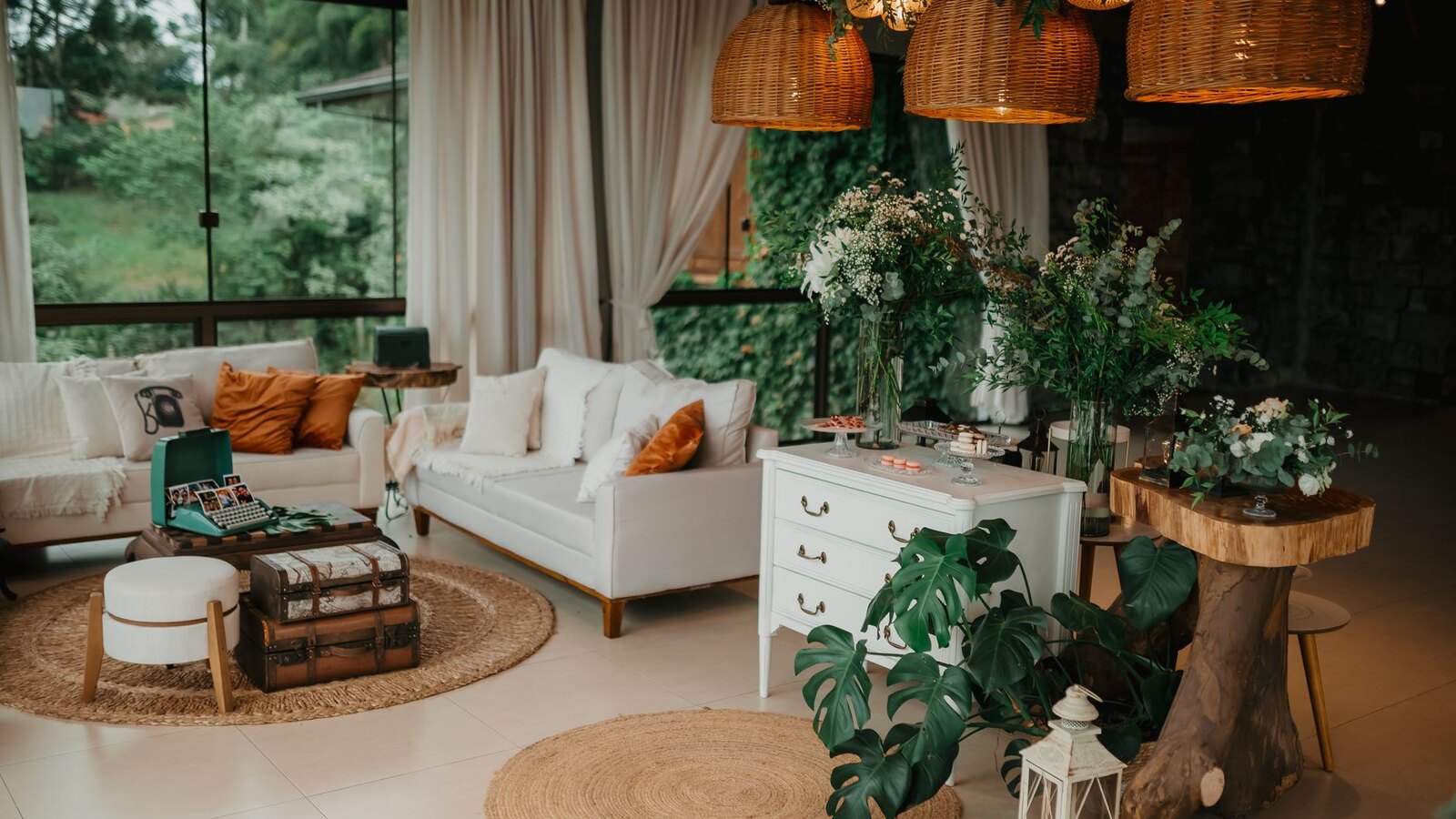
Photo: Jonathan Borba / Pexels
You clear the coffee table, step back, and the room suddenly looks calmer. Then the books, candle, bowl, plant, remote, and travel objects return, and the question appears again: is this a layered boho living room or simply a crowded one?
The difference is not the number of things.
A collected room has hierarchy, repetition, and memory. A cluttered room gives every object the same volume and every surface the same job.
Boho style can hold pattern, old furniture, plants, textiles, art, and objects from different places. What it cannot hold indefinitely is equal emphasis. Something has to lead, several things have to support it, and some space has to remain quiet.
The collected-versus-cluttered test
| Collected | Cluttered |
|---|---|
| One clear visual anchor | Several unrelated focal points |
| Colors recur in different materials | Every object introduces another color |
| Patterns vary in scale | Patterns compete at the same scale |
| Objects are grouped into finite zones | Small objects spread across every surface |
| Empty space separates strong moments | Every gap is treated as unfinished |
| Pieces have provenance or personal meaning | Objects were bought to perform a theme |
| Daily-use clutter has concealed storage | Remotes, cables, and paperwork join the display |
This is why a room can contain twenty visible objects and feel settled while another contains eight and feels restless. Order is not the same as emptiness.
1. Start with one object large enough to organize the room
The first purchase should not be a set of cushions. Begin with something that can establish scale: a rug, sofa, large textile, painted wall, or substantial piece of art.
A strong rug is often the easiest starting point because it controls both the seating area and the palette. Choose one with enough visual information to guide later decisions, then stop asking every new object to create another direction.
If the rug contains rust, cream, faded indigo, and olive, those colors become a working vocabulary. They do not have to match exactly. They simply need to return often enough that the eye understands the relationship.
This is the first division between collected and cluttered. A collected room has an anchor. A cluttered room has evidence of shopping.
2. Repeat colors, not products
Matching sets make boho style feel manufactured. Total difference makes it feel accidental. Repeated color solves both problems.
Choose three main tones and one smaller accent. Let them travel through different materials:
- Rust in a rug, glazed ceramic, and one cushion
- Olive in a plant, painting, and throw
- Cream in upholstery, curtains, and a lampshade
- Black in two frames and a thin metal floor lamp
The repetition can be uneven. A color may dominate one surface and appear only as a thread somewhere else. That is enough to create rhythm without making the room look packaged.
Avoid buying the rug, pillow, wall hanging, and basket from one “boho” collection. The pieces will coordinate, but they will also share the same commercial accent. The room will look themed rather than formed over time.
3. Mix pattern by scale
Pattern does not create clutter by itself. Similar patterns competing at similar sizes do.
Use three levels:
- Large: the broad geometry of a rug, curtain, or upholstered chair
- Medium: a cushion, throw, or artwork with a clearly readable motif
- Small: a woven texture, narrow stripe, or detailed ceramic surface
One pattern should be visible from the doorway. Another should appear from the sofa. The smallest should reward closer attention.
When every pattern is medium-sized, the room vibrates without a resting point. When one is large, one medium, and the rest mostly textural, the eye can move through the room instead of confronting everything at once.
Pattern also needs plain material around it. A strong rug benefits from a quieter sofa. A patterned chair needs either a calm wall or a restrained floor. Freedom works because something provides resistance.
4. Give collections a boundary
Three ceramic vessels on one shelf can read as a collection. The same three vessels separated across a mantel, side table, and media unit read as unfinished styling.
Grouping turns objects into a sentence.
Use a tray, shelf, cabinet top, or defined section of a bookcase as the boundary. Vary the heights, leave small gaps, and let at least one object be larger than the rest. When every piece is the same size, the group resembles stock. When every piece is dramatically different, it loses rhythm.
A boundary is also permission to stop. Once the shelf or tray is complete, the next object has to replace something rather than expand onto another surface.
This is particularly useful when a collection carries real memory. Travel objects, inherited ceramics, old books, and handmade pieces deserve a place where their differences can be read. Scattering them converts their stories into background noise.
Our guide to giving a home a more personal touch follows the same principle: meaning becomes visible when it is edited into the room, not when it is distributed everywhere.
5. Leave air around the handmade object
Boho style borrows much of its visual richness from craft. That makes provenance more important, not less.
A handwoven textile, carved stool, basket, or ceramic vessel should have enough space for its material and construction to be seen. Surrounding it with six factory-made “global” accessories does not make the display richer. It makes the original object harder to notice.
Buy fewer pieces from identified makers when possible. Learn what a pattern or technique is called and where it comes from. Avoid anonymous labels such as “tribal” when a seller cannot identify a community, region, or process.
This is not a demand for an expensive room. Vintage pieces, local ceramics, family textiles, and ordinary objects with visible repair can carry more presence than a cart full of themed accessories.
The object does not need to be precious. It needs to be legible.
6. Cluster plants instead of placing one everywhere
Plants are one of the quickest ways to soften a boho living room, and one of the quickest ways to make every surface harder to use.
Create one or two plant zones. Combine different heights and leaf shapes, but repeat the planter material or color. A floor plant, medium plant on a stand, and smaller plant on a shelf can form a single green composition.
Then leave other surfaces alone.
A plant on the coffee table, side table, media unit, shelf, windowsill, and cabinet creates maintenance before it creates a garden. Watering becomes awkward, leaves interrupt circulation, and every surface loses its original function.
The best plant zone responds to real light. It should not require moving half the room every week to keep the plants alive. If the available daylight supports only two plants, two healthy plants are better design than eight struggling ones.
7. Use texture where another color would be too much
A room can feel layered without adding another hue.
Once the palette is established, introduce difference through:
- Nubby wool against smooth cotton
- Woven cane against painted wood
- Matte ceramic beside glass
- Linen curtains behind velvet or leather seating
- A flat-weave rug beneath a deeper pile cushion
- A repaired or aged surface beside something newer
Texture works best when it can be touched or when light reveals it. A woven object placed in a dark corner may register only as another brown shape. Move it near a window or lamp, and the construction becomes visible.
This is where warm lighting matters. One ceiling fixture flattens a textured room. A floor lamp near a chair, a table lamp beside ceramics, and a low light washing a wall allow the surfaces to separate after sunset.
8. Keep daily clutter out of the composition
A collected room still needs somewhere for the remote, charging cable, unopened mail, game controller, and glass of water.
Do not ask decorative objects to coexist indefinitely with unresolved daily storage. Give frequently used items a closed box, drawer, lidded basket, or cabinet within reach of where they are used.
Then edit the display before adding more storage furniture. The Kooihaus review of small living room mistakes found that rooms often suffer from both overfilled surfaces and furniture with no clear job. Buying another cabinet is not automatically the answer.
The room should be able to return to order in ten minutes. If restoring it requires relocating twenty decorative objects, the styling system is too fragile for daily life.
9. Leave one surface deliberately quiet
A boho living room does not require every wall, shelf, and tabletop to demonstrate the style.
Choose one quiet surface:
- A wall with one large artwork
- A side table holding only a lamp
- A section of shelving left mostly open
- A coffee table with one broad bowl
- A window without hanging plants or extra ornaments
That surface acts as punctuation. It gives the stronger patterns and collections somewhere to end.
This does not make the room less personal. It makes the personal objects easier to see.
If you are working closer to maximalism, the Kooihaus guide to maximalist interior design applies the same discipline at a higher volume.
A ten-minute boho living room edit
Stand in the doorway and identify the first object you see. If three objects demand attention simultaneously, choose one and reduce the contrast around the others.
Then:
- Remove every small object from the coffee table.
- Return only what has a practical or personal reason to be there.
- Gather scattered ceramics, books, or plants into groups.
- Count the room’s dominant colors and remove the one that appears only once.
- Check whether two patterns are competing at the same scale.
- Clear one surface completely.
- Photograph the room again from the doorway.
The camera is useful because it flattens depth. Objects that seemed comfortably separated in person may collapse into one busy field in the image. That does not mean the photograph is more truthful than the room, but it exposes competition quickly.
Frequently asked questions
What makes a living room look boho?
A boho living room combines relaxed furniture, layered textiles, plants, art, natural materials, vintage pieces, and meaningful objects. The strongest rooms repeat colors and materials without relying on matching sets.
How do you make boho decor look less cluttered?
Use one large anchor, group small objects, vary pattern scale, repeat a limited palette, conceal daily-use clutter, and leave at least one wall or surface quiet.
Can a small living room have boho style?
Yes. Use texture and meaningful objects rather than a high object count. One strong rug, a compact plant group, warm lighting, and a few well-spaced pieces can create the style without consuming every surface.
Does boho decor require lots of color?
No. A room can use cream, brown, black, and one earthy accent while creating richness through wood, linen, wool, cane, ceramic, and plants.
A collected room does not look finished because it is full. It looks finished because each object has entered a relationship with something else, and because the room still has enough air to show us what those relationships are.











 Blankets and Throws
 Home Accessories
 Furniture
 Rugs
Rugs Cushions
 Kitchen
 Cutlery and Dinnerware
 Drinkware
 Table Mats and Coasters
 Dining Accessories
 Tablecloths and Napkins
 Decorative Items
 Vases and Planters
 Wall Decor
 Bathroom Accessories
 Bathroom Storage
 Bath and Shower Mats
 Towels