FREE WORLDWIDE TRACKED SHIPPING

How to Size Ceiling Lights for Small Bedrooms
 By Laura Jones
Find the right ceiling light size for a small bedroom, with practical guidance on fixture diameter, ceiling height, and layered lighting
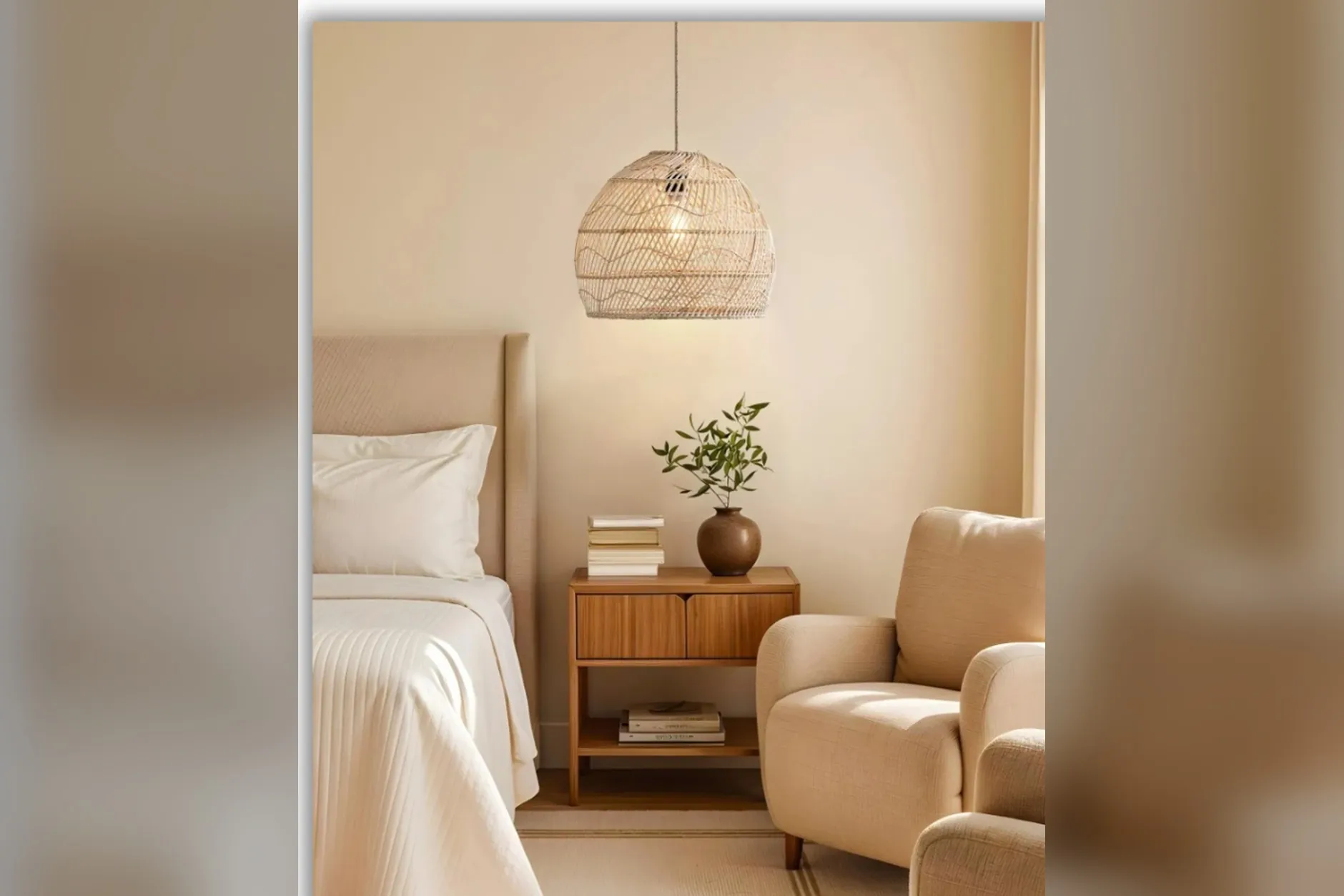
Woven bedside pendant in a bedroom
A small bedroom doesn’t have to settle for a ceiling light that looks like an afterthought. The right fixture can make a compact room feel more open, balanced, and visually taller without taking up valuable space. The secret isn’t simply choosing a smaller light; it’s finding the right combination of fixture size, ceiling height, and visual weight.
Flush mounts are often the easiest solution when headroom is limited. But they are not the only option. If bedside surfaces are tight, using slim bedroom pendant lights instead of bulky table lamps can free up useful nightstand space while giving the room a more intentional layout.
The best plan usually combines both ideas: keep the central ceiling fixture compact in profile, then move some of the task lighting to the wall or bedside zone.
What Size Ceiling Light for a Small Bedroom?
A widely used sizing shortcut in U.S. lighting guides is simple:
Add the room's length and width in feet. Use that total as an approximate fixture diameter in inches.
For example:
10 ft + 10 ft = approximately 20 inches.
So for a 10-by-10-foot bedroom, a ceiling fixture around 20 inches in diameter is a reasonable starting point.
Here are a few quick examples:
| Bedroom Size | Starting Fixture Diameter |
|---|---|
| 8 × 8 ft | About 16 in. |
| 9 × 10 ft | About 19 in. |
| 10 × 10 ft | About 20 in. |
| 10 × 12 ft | About 22 in. |
But treat that number as a center point, not a rule carved into stone.
A 20-inch clear or open fixture may feel visually light in a 10-by-10 room. A dense woven shade or solid metal fixture at the same diameter may feel much larger.
This is why the question “what size ceiling light for small bedroom?” has two answers: calculate the approximate diameter first, then adjust for visual weight and ceiling height.
Ceiling Height Matters as Much as Diameter
Width tells you whether a fixture feels proportional. Projection tells you whether it feels comfortable.
For a bedroom with an eight-foot ceiling, or anything lower, the distance from the ceiling to the lowest point of the fixture becomes especially important.
A broad, shallow fixture can often work better than a smaller light that hangs farther down.
Before buying, check:
- fixture diameter;
- overall height;
- ceiling-to-lowest-point projection;
- shade depth;
- whether the fixture sits over a walkway or over the bed.
For very compact bedrooms with low ceilings, flush mounts in roughly the 14- to 18-inch range can sometimes feel more appropriate than a full 20-inch fixture, especially when the shade is visually dense or the room is well under 100 square feet.
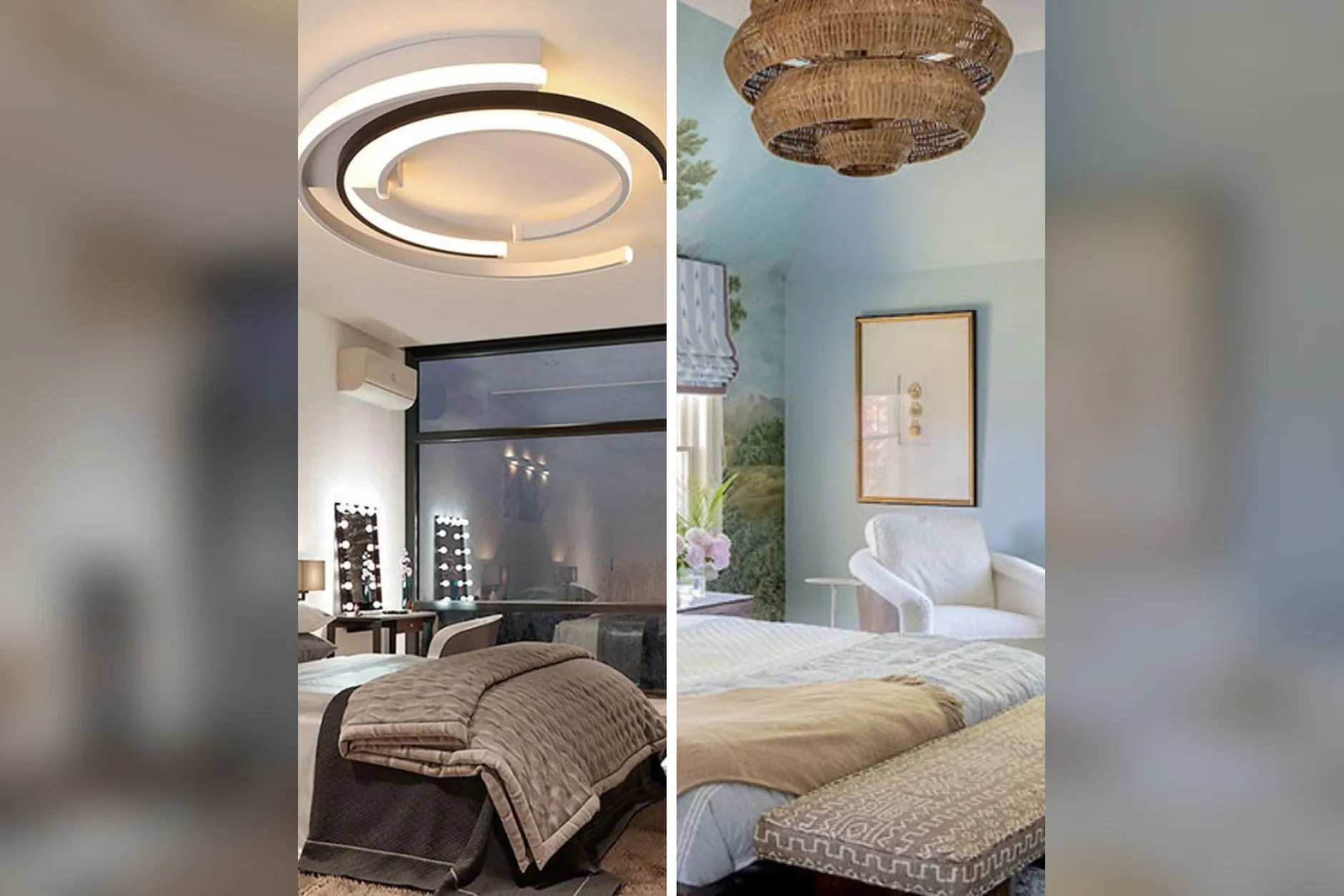
That does not contradict the room-sizing formula. It simply means scale should be adjusted for the actual fixture design.
Diameter gives you proportion. Projection protects the room's vertical space.
Use Light to Keep the Corners From Disappearing
Small rooms tend to feel even smaller when the walls and corners disappear at night.
You do not need to illuminate every inch equally.
But a little light on the perimeter helps the eye understand the full dimensions of the room.
For example:
- a wall sconce beside the bed can light both the reading zone and the wall;
- a small lamp near a dresser can prevent one corner from going completely dark;
- concealed LED lighting on shelving can add depth without another visible fixture;
- a semi-flush fixture with some upward light can make the ceiling plane feel more open.
When planning these layers, browsing broader bedroom lighting at Rowabi can help you compare pendants, ceiling lights, and wall fixtures as parts of one lighting plan rather than separate purchases.
The point is not to fill a small bedroom with more fixtures. It is to make each one solve a specific problem.
Flush Mounts Are the Safest Choice for Low Ceilings
Flush mounts sit directly against or very close to the ceiling, which makes them particularly useful in small bedrooms.
They preserve headroom and keep the ceiling plane visually cleaner.
That is especially helpful if the room already has:
- a large bed relative to the floor area;
- tall wardrobes;
- limited walking space;
- a ceiling around eight feet high;
- furniture that already feels visually heavy.
But flush mount does not have to mean a plain white disk.
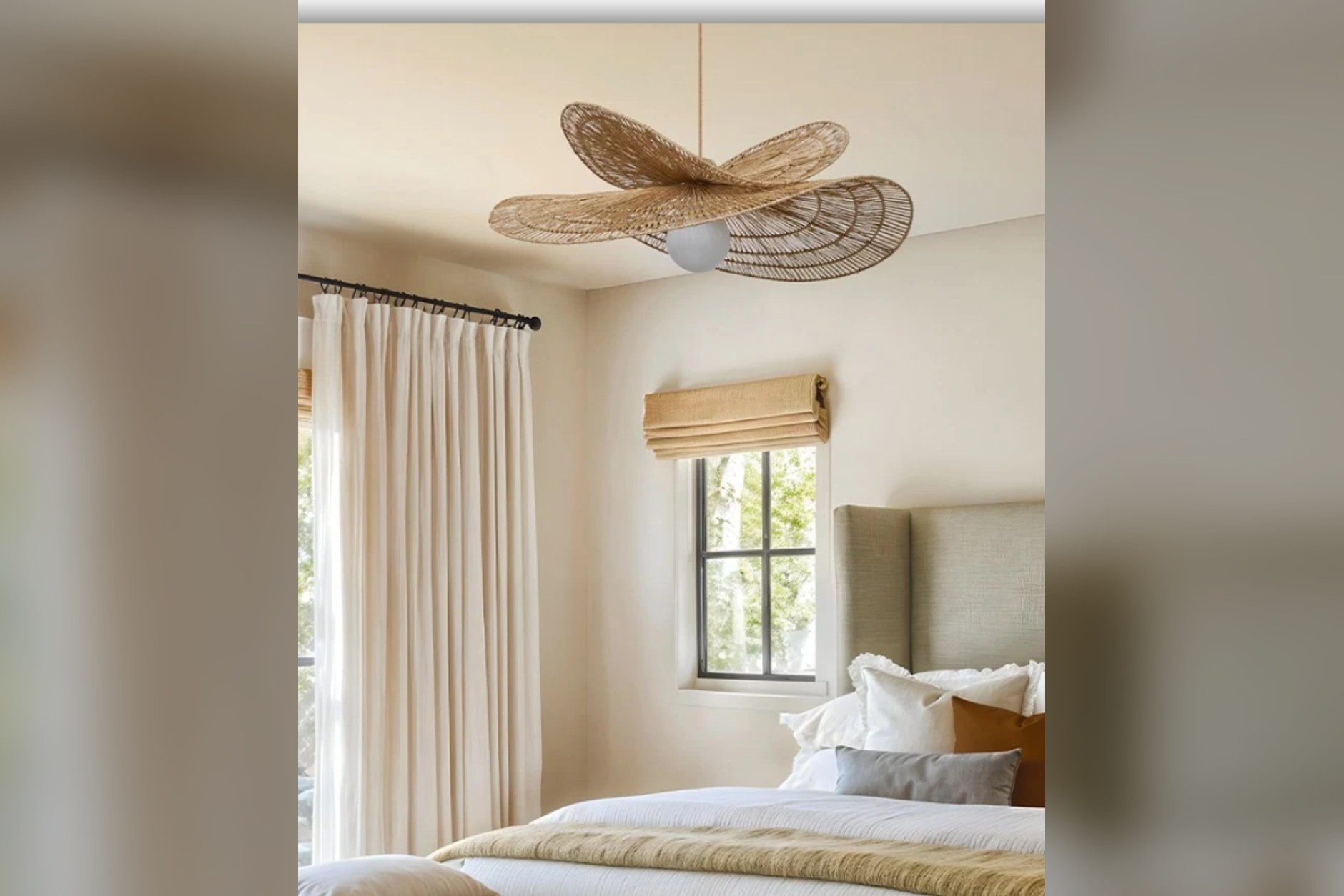
Modern versions can use woven fiber, rattan, glass, metal, linen-like materials, or sculptural shallow forms. These materials can add personality without requiring a long vertical drop.
Natural woven shades are particularly useful when a small bedroom contains mostly smooth surfaces. The ceiling fixture can introduce texture without adding another piece of furniture to the floor plan.
In a compact room, that is a useful trade: more visual interest, no additional floor footprint.
Semi-Flush Mounts Add Depth Without a Full Pendant Drop
A semi-flush mount sits slightly below the ceiling rather than directly against it.
That small gap gives the fixture more visible shape and can allow some light to reach the ceiling above it.
In the right room, that upward light can make the ceiling feel less flat.
Semi-flush fixtures work best when the bedroom has enough clearance to spare a few inches but not enough for a traditional pendant or chandelier in the main walking area.
Before choosing one, check the total fixture depth carefully.
Some products marketed as semi-flush are only a few inches deep. Others project 10 or 12 inches or more. In a small room with an eight-foot ceiling, that difference is significant.
If the fixture sits over the bed rather than a walkway, you may have slightly more freedom because no one regularly walks directly beneath it.
Still, check the sightline from the doorway and from the bed. A fixture can be technically high enough and still feel visually heavy.
Bedside Pendants Can Give Small Rooms Back Their Nightstands
In a small bedroom, bedside furniture often has to work harder. A compact nightstand may need to hold a phone, book, glass of water, charger, and personal items. Add a large table lamp and most of the useful surface disappears.
That is why hanging bedside lights have become such a practical alternative.
A pendant suspended beside the bed moves the light source off the furniture entirely. It can also make the room feel more tailored because the lighting becomes part of the architecture rather than another object sitting on a table.
As a starting point, many lighting guides place a bedside pendant roughly 24 to 30 inches above the top of the nightstand.
But the final position should be tested from the bed.
Check:
- whether the bulb or bright opening is visible at eye level;
- whether the shade interferes when getting in or out of bed;
- how far the fixture sits from the mattress;
- whether the switch is easy to reach;
- whether the light actually reaches the reading area.
Softly diffused shades work especially well in compact bedrooms because harsh light is more noticeable when walls and furniture are close together.
Linen, frosted glass, and open woven materials can all soften the visual effect, although each handles light differently.
Before You Order For Your Bedroom
A small bedroom is usually experienced from the doorway before anywhere else. That makes the doorway one of the best places to test a ceiling fixture visually.
Before buying, create a quick paper or cardboard template matching the approximate diameter of the fixture.
If possible, mark its lowest point with string.
Then stand in the doorway and ask:
- Does the fixture look too small compared with the bed?
- Does it dominate the ceiling?
- Does it make the ceiling appear lower?
- Does the bed still feel like the main focal point?
Then sit on the bed and check again.
A ceiling fixture can look perfectly balanced while standing and feel much more dominant from a seated position.
A five-minute mock-up is often more useful than trying to judge scale from a product photo.
Measure First, Then Choose the Style
For small bedroom light fixtures ceiling planning, the best order is simple:
- Measure the room length and width.
- Use the length-plus-width formula to estimate fixture diameter.
- Check ceiling height and total fixture projection.
- Adjust for visual weight.
- Decide whether bedside lamps are using too much surface space.
- Add only the lighting layers the room actually needs.
For a 10-by-10-foot bedroom, around 20 inches is a useful starting diameter, not a requirement. A heavier fixture may look better slightly smaller, while an open or lightweight design may comfortably go a little larger.
If the ceiling is low, prioritize a shallow profile. If nightstands are small, consider moving bedside lighting onto the wall or ceiling. And if the room still feels cramped after dark, look at the corners before buying a brighter central bulb. A small bedroom rarely needs more lighting everywhere. It needs the right amount of light in the right places.
For shoppers considering Rowabi, the brand currently offers free standard shipping on orders over $200 within the contiguous United States. Its standard shipping policy states that in-stock orders typically ship in 1-2 business days, with UPS or FedEx transit generally taking another 3-5 business days after shipment.





 Blankets and Throws
 Home Accessories
 Furniture
 Rugs
 Cushions

 Kitchen
 Cutlery and Dinnerware
 Drinkware
 Table Mats and Coasters
 Dining Accessories
 Tablecloths and Napkins

 Decorative Items
 Vases and Planters
 Wall Decor

 Bathroom Accessories
 Bathroom Storage
 Bath and Shower Mats
 Towels