FREE WORLDWIDE TRACKED SHIPPING

Pendants Over an Island or Dining Table: Heights, Spacing, and Why Wood Earns Its Place
 By Laura Jones
The pendant over a kitchen island gets more attention than any other light in the house, and it is almost always hung by guesswork
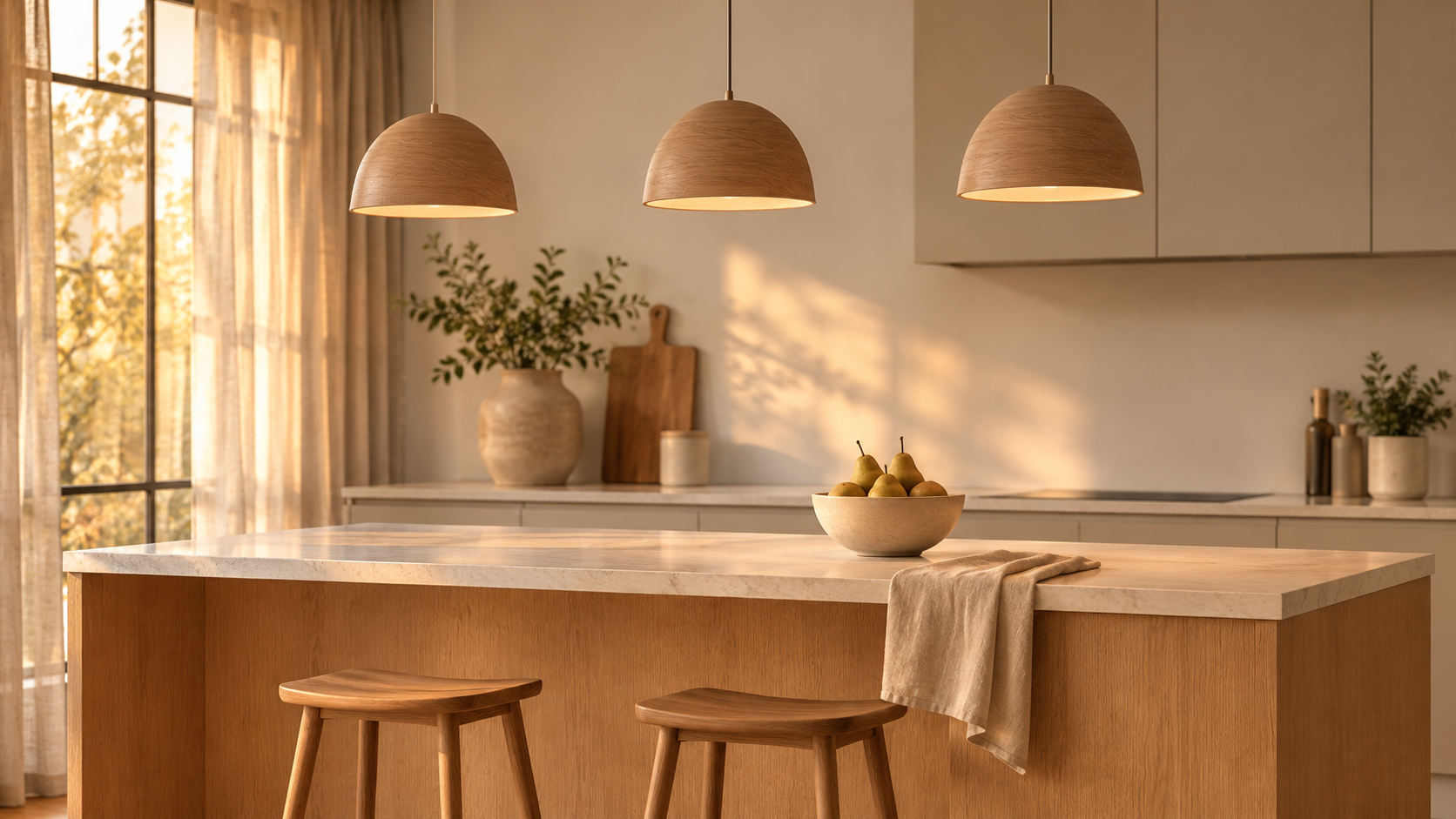
The pendant over a kitchen island gets more attention than any other light in the house, and it is almost always hung by guesswork. Someone holds it up, someone else squints from the doorway, and the electrician cuts the cord wherever the arguing stops. Then the household lives under that decision for the next fifteen years.
I would rather it went the other way round: settle the height and spacing first, then choose a fixture that suits the numbers. That order also explains why so many designers keep returning to simple shapes. When you look at a fixture every time you cook, a plain dome or cylinder from a good range of minimalist pendant lights tends to wear better than something sculptural that only looks right in a showroom photo. The shape stays quiet, and the light does the work.
What follows are the measurements that matter, the mistakes I see most often, and a case for wood that has more to do with how it ages than how it looks on day one.
Start With the Number Under the Shade
For both kitchen islands and dining tables, the standard guidance is 30 to 36 inches (76 to 91 cm) between the surface and the bottom of the fixture. This Old House gives the same range for each, and most manufacturers’ install sheets agree.
That range assumes an 8-foot (2.44 m) ceiling. In taller rooms, the usual adjustment is about 3 inches (7.5 cm) of extra clearance for every additional foot of ceiling, which I treat as a starting point rather than a law. Then test it. Tape a piece of cardboard the size of the shade to a broom handle, hold it at the planned height, and sit on a counter stool. If the shade cuts across the face of the person opposite you, raise it. If you see the bulb before you see light on the counter, lower it or choose a deeper shade.
The two surfaces want slightly different answers. People stand and lean over an island, so I aim for 32 to 34 inches (81 to 86 cm) there. Everyone sits at a dining table, so 30 to 32 inches (76 to 81 cm) keeps the glow low and close while staying above seated eye level.
How Many Pendants, and How Far Apart
Count and spacing matter as much as height. A row that is too tight looks like a light fixture display; a row that is too loose leaves dark patches exactly where you chop.
| Surface | Typical pendant count | Spacing guide |
|---|---|---|
| 6 ft (1.8 m) island | 2 | Divide the length into three equal parts and hang at the two dividing points |
| 8 ft (2.4 m) island | 3 | About 24 to 30 in (61 to 76 cm) between the centers of the shades |
| 48 in (122 cm) round table | 1 | Shade roughly half to two-thirds the table’s width |
| 72 in (183 cm) rectangular table | 2 or 3, or one linear fixture | Keep at least 6 in (15 cm) of table beyond the end fixtures |
Leave about 18 inches (46 cm) between the end pendants and the ends of an island so nobody catches a shade while leaning in. Odd numbers look settled over a long island, but two well-sized pendants suit a short one far better than three crowded ones.
Why Simple Shapes Hold Up
Most kitchens now sit inside an open plan, which means the island pendants are visible from the sofa, the dining table, and the front door. A row of plain shades reads as one calm horizontal line from across the room. A row of busy ones reads as three separate objects competing for attention.
This is the same shift Kōōihaus described as warm minimalism replacing blank minimalism: fewer things, but each one with texture and a material you can feel. A simple pendant gives you that restraint, and the material gives you the warmth.
Shade construction decides what kind of light you get. An opal glass globe glows in every direction and lights faces. An open-bottomed metal or wood dome throws a defined pool onto the counter, which is better for prep work. Over an island I prefer the pool; over a dining table I prefer the glow. Whichever you choose, keep every fixture in the space at the same warm color temperature, a point Kōōihaus covers well in its guide to dining room color temperature.
The Case for Wood
Metal and glass look finished on the day they are installed. Wood looks better a few years in. If you want warmth without adding color to a pale kitchen, natural wood lighting is the easiest way to get it, because the material carries that warmth even when the switch is off.
It also keeps changing, and that is worth understanding before you buy. According to the USDA Forest Service’s Forest Products Laboratory, the color change wood shows indoors is caused by visible light rather than UV, which is why a UV stabilizer in an interior finish does little to stop it. In practice, a light oak or ash shade will drift over time, and so will the wooden table or cabinets beneath it. Put them in the same light, and they tend to drift together, which is part of why a wood pendant over a wood table looks right in a way a brand-new matched set never quite does.
How the wood is made changes the light, too. Thin veneer can let a little light through and glow warmly. Solid turned wood is opaque, so an open-bottomed shade directs light down toward the surface. Whatever you pick, use LED bulbs and stay within the maximum wattage printed on the fixture label.
Where It Usually Goes Wrong
Hanging to the ceiling box, not the furniture. The box is rarely centered on the island. Center the pendants on the surface and move or swag the connection if you have to.
Choosing a shade that is too small. Under-sized pendants look like they are floating away. If you are torn between two sizes, the larger one is usually right.
Mixing color temperatures. A 2700K pendant beside 4000K downlights makes the wood look orange, and the counter look gray.
Skipping the dimmer. The same pendant needs to light homework at 6 p.m. and dessert at 10 p.m. A compatible LED dimmer handles both.
Frequently Asked Questions
How high should pendants hang over a kitchen island?
Leave 30 to 36 inches (76 to 91 cm) between the countertop and the bottom of each shade on an 8-foot ceiling, adding about 3 inches for each extra foot of ceiling height.
How far apart should island pendants be?
Roughly 24 to 30 inches (61 to 76 cm) between the centers of the shades, with about 18 inches (46 cm) kept clear at each end of the island.
Do wood pendant lights change color over time?
Yes. Indoor color change in wood comes from visible light, so expect some deepening or fading depending on the species. Most people find it adds character rather than wear.
Can I mix wood and metal pendants in one room?
Yes, as long as one material leads. Use wood over the island and a slim metal fixture elsewhere, or the reverse, and keep the color temperature consistent across both.
Final Words
Good island lighting is mostly arithmetic and a cardboard test. Get the height and spacing right, keep the shape simple, and choose a material that will still look honest in ten years. The pendant should feel like it has always been there, which is the best compliment a light fixture can get.




 Blankets and Throws
 Home Accessories
 Furniture
 Rugs
 Cushions

 Kitchen
 Cutlery and Dinnerware
 Drinkware
 Table Mats and Coasters
 Dining Accessories
 Tablecloths and Napkins

 Decorative Items
 Vases and Planters
 Wall Decor

 Bathroom Accessories
 Bathroom Storage
 Bath and Shower Mats
 Towels