FREE WORLDWIDE TRACKED SHIPPING

IKEA’s FÖRSÄLJARE Sideboard Makes Mid-Century Storage Feel Lighter
 By Alex Carter
IKEA's FÖRSÄLJARE sideboard combines a shallow case and sliding doors with a mid-century look. Here is what to measure and check before buying
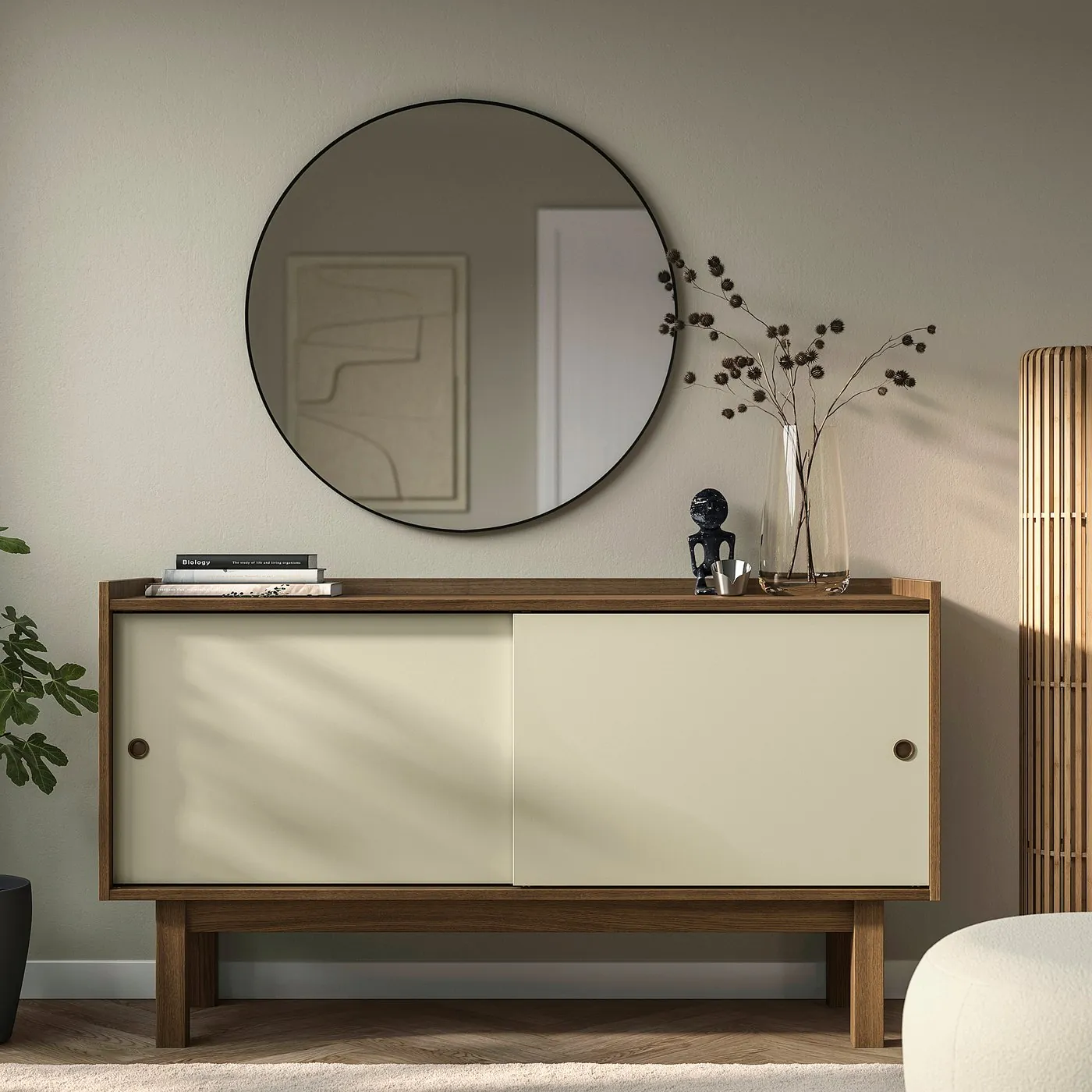
Image: IKEA.
US price and product details were checked on IKEA’s website on October 29, 2026, and may change. This is a specification-based design assessment, not a hands-on test.
A sideboard can solve a storage problem and create another one. Add a deep, heavy cabinet to a narrow dining nook or entry, and the room gains shelves but loses the clear path that made it usable. IKEA’s new FÖRSÄLJARE sideboard is interesting because it tries to keep the visual character of a mid-century cabinet within a relatively shallow 17 7/8-inch depth.
The raised legs, long horizontal body, dark wood effect, pale sliding doors, and small round pulls do most of the period work. The practical question is whether those cues are attached to storage that fits a small home. At 55 inches wide and 30 3/4 inches high, this is not a tiny cabinet. It is a low, shallow one, and that difference should decide where it goes.
The IKEA FÖRSÄLJARE sideboard at a glance
IKEA lists the FÖRSÄLJARE sideboard at $249 on its US site. The cabinet includes two sliding doors, one hidden soft-closing drawer, an adjustable shelf, and adjustable feet. It arrives in two packages and requires secure wall anchoring.
| Specification | IKEA listing | Why it matters |
|---|---|---|
| Width | 55 in. | Needs a real wall, not a leftover corner |
| Depth | 17 7/8 in. | Shallower than many dressers, but still needs circulation space |
| Height | 30 3/4 in. | Works below art, a mirror, or many wall-mounted TVs |
| Storage | Sliding doors, adjustable shelf, hidden drawer | Doors do not swing into a narrow route |
| Materials | Particleboard and fiberboard with paper foil, plastic edging, and acrylic paint | Creates the wood look without solid wood or veneer |
| Current US price | $249 | Verified on October 29, 2026 |
The measurements and materials come from the official IKEA US product page. Availability is location-dependent, so the page confirms a US listing but not stock at every store or ZIP code.
Why it reads as mid-century modern
FÖRSÄLJARE does not reproduce one historic cabinet. It borrows a familiar mid-century grammar: a wide case lifted from the floor, straight legs, a warm brown wood tone, restrained hardware, and a strong horizontal proportion. The pale doors interrupt the brown shell, keeping the front from becoming one dark block.
The legs matter most. Lifting the cabinet exposes floor beneath it, which makes a 55-inch piece feel lighter and gives the profile the furniture-like stance associated with 1950s and 1960s case goods. The circular recessed pulls provide a small graphic accent instead of adding large handles. Readers who want the wider visual context can compare those cues with our guide to mid-century modern interiors.
The non-interchangeable detail is the top rail. It creates a shallow rim around the surface, so the cabinet reads less like a box and more like a low tray on legs. That rim also changes use: it visually contains a lamp, books, or serving pieces, but it can make wiping crumbs from the edge a little slower.
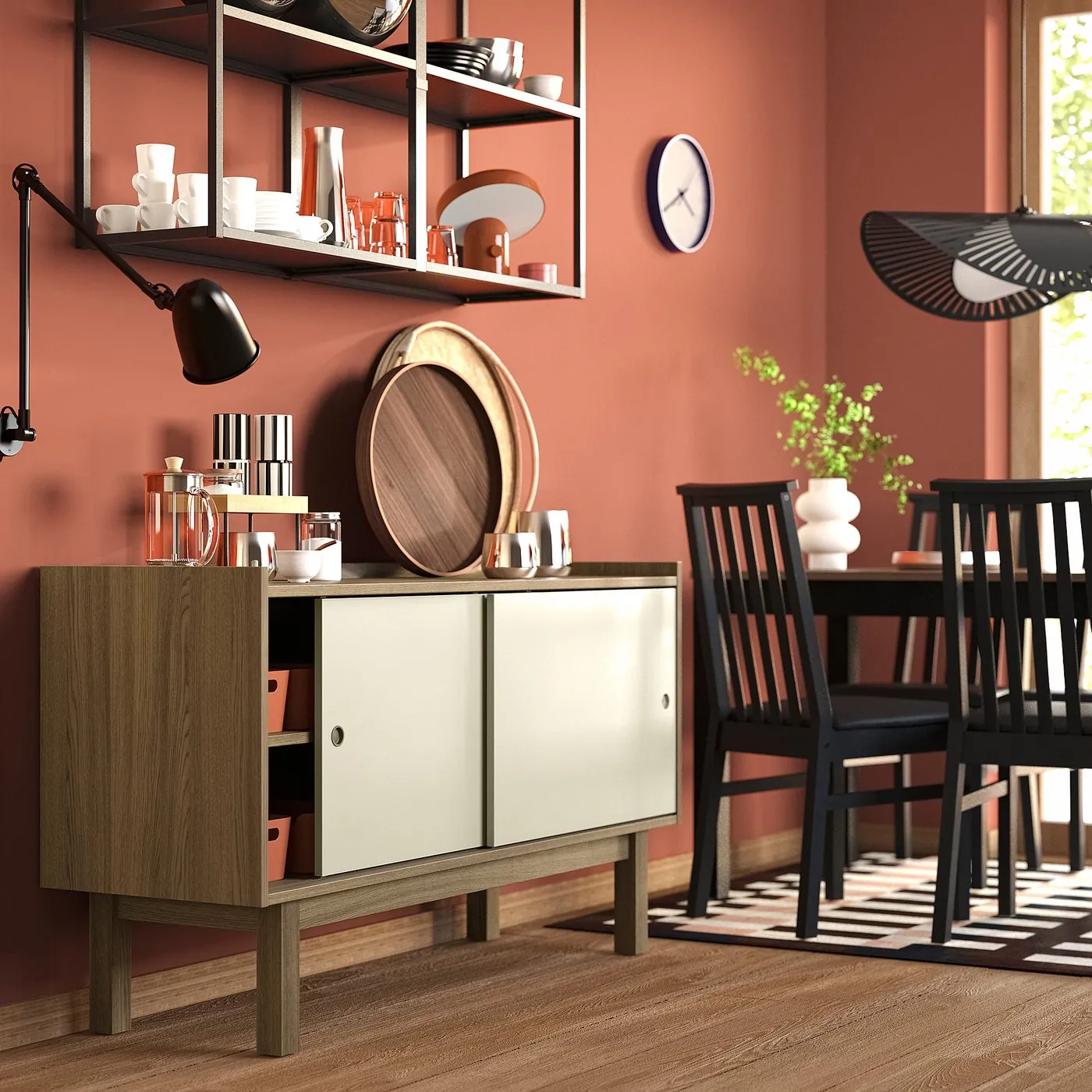
Small-space value comes from the doors, not the width
Sliding doors are the useful move. A hinged door needs a clear arc in front of a cabinet, exactly where a dining chair, entry route, or bed may already compete for space. FÖRSÄLJARE keeps access close to the case. The adjustable shelf lets the interior shift between dishes, games, folded clothes, or media equipment.
Its 55-inch width is the trade-off. In a small room, a long cabinet can work when it consolidates several smaller storage pieces and leaves the rest of the wall quiet. It fails when it is squeezed beside another cabinet or forces people to turn sideways. Our entryway storage guide uses the same test: protect circulation before adding capacity.
Before buying, tape a 55-by-17 7/8-inch rectangle on the floor. Then add the route people actually use in front of it. The cabinet’s shallow depth is an advantage only if that route remains comfortable.
Four placements that make sense
In a small dining nook
Use it on the wall parallel to the table, where sliding doors can open without hitting chair backs. The top can hold a lamp and serving tray, while the shelf stores dishes. Leave enough distance to pull out the nearest chair. The room image from IKEA shows why the low profile works: storage sits below the main sightline rather than building a second tall wall.
In an entry
The hidden drawer suits keys, mail, and sunglasses, while closed storage keeps shoes or bags from becoming the first view into the home. This placement needs the strictest depth check. A sideboard is useful in an entry only when it does not narrow the route to the door.
Under a wall-mounted TV
The 55-inch width can balance a medium television, and the sliding doors avoid swing clearance. IKEA does not list cable management openings, so check the back and plan how cords will exit before treating it as a media console. Do not assume a shelf load rating applies to the top. IKEA publishes a maximum of 40 pounds per shelf, not a stated top-panel TV load.
As a bedroom dresser
The hidden drawer can handle smaller items, but most clothing would sit behind sliding doors rather than in conventional drawers. That arrangement suits folded sweaters and linens better than a person who wants a separate drawer for every category. For more help judging what deserves the budget, see our guide to where furniture spending pays off.
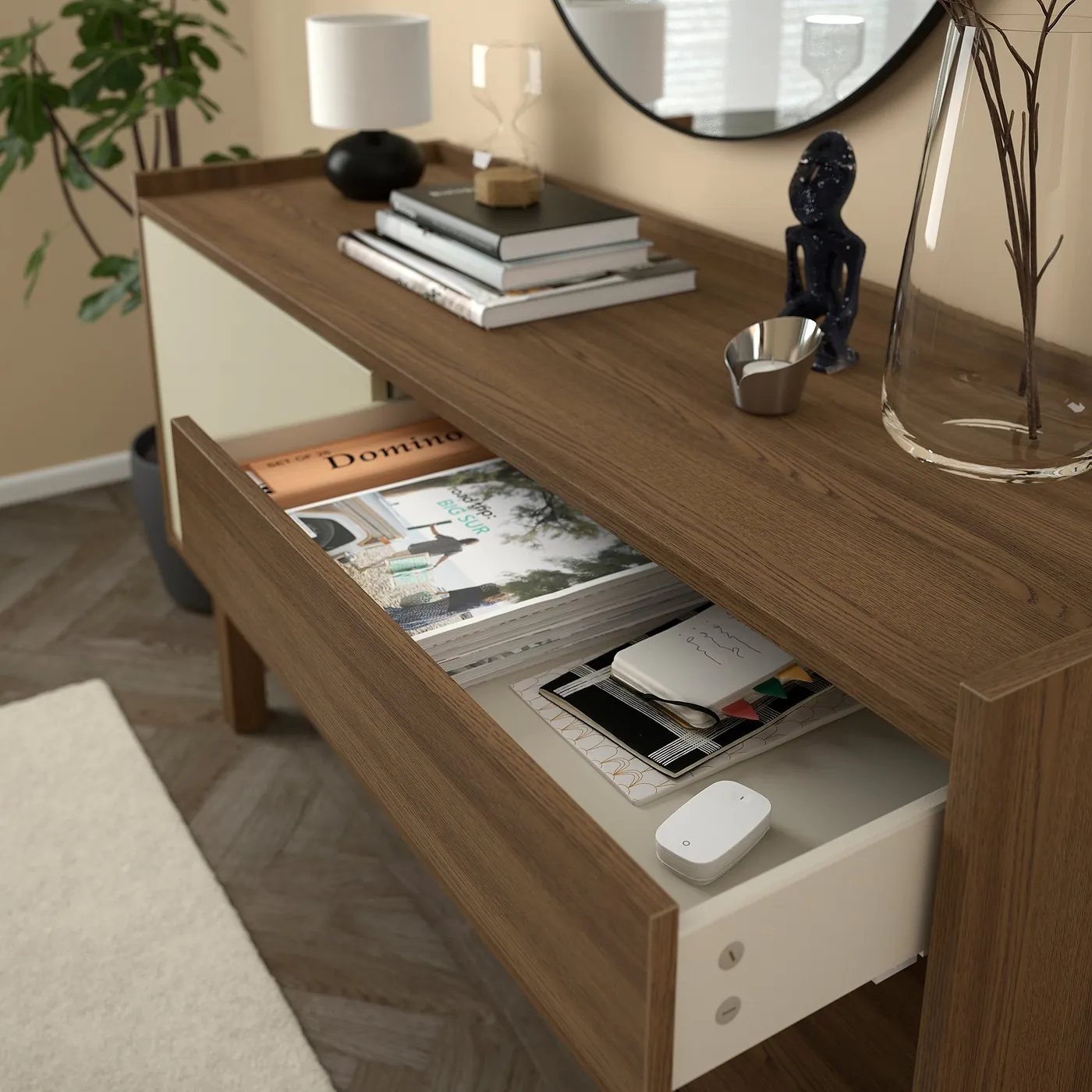
How to style it without turning it into a period set
The cabinet already carries several retro signals, so it does not need a starburst clock, teak accessories, and a globe lamp all at once. Start with one rounded object to echo the pulls, such as a circular mirror or a ceramic lamp. Add one taller vertical element, then keep part of the top empty.
A warm wall color strengthens the brown frame, while a pale neutral wall makes the dark wood effect more graphic. If the room already has several wood tones, connect them with one shared temperature rather than chasing an exact match. The dark beige wood effect can sit with oak, walnut, or painted furniture when another element repeats either the brown shell or the light doors.
For a quieter mix, borrow from Japandi furniture principles: low profiles, useful negative space, and fewer objects with clearer jobs. The cabinet should anchor the wall, not become a shelf for every decorative object the room owns.
What the materials mean in daily use
This is not solid wood furniture. IKEA lists particleboard with paper foil for the top, shelf, bottom, partition, leg frame, doors, and several other parts. Fiberboard appears in the back, drawer bottom, and legs. Plastic edging protects selected exposed edges, and acrylic paint is used on parts of the back and drawer bottom.
That construction makes the uniform color and $249 price possible, but it changes the maintenance and repair story. A paper-foil surface should be protected from standing water, abrasion, and hot serving pieces. It cannot be sanded and refinished like solid wood. Use coasters or a tray beneath drinks, lift objects rather than dragging them, and wipe spills promptly with the mild-cleaner method IKEA specifies.
The adjustable feet are valuable on an uneven floor because sliding doors reveal a cabinet that is out of level. The wall anchor is not optional. IKEA’s safety instruction says the piece must be securely anchored with suitable screws and plugs for the wall.
Assembly and delivery checks
FÖRSÄLJARE comes in two packages. IKEA lists them at 51 pounds 8 ounces and 48 pounds 13 ounces, with the longer package measuring 56 1/2 inches. That is almost 101 pounds of boxed material in total, divided into two long cartons. Measure the vehicle, elevator, stair turns, and doorway before pickup.
IKEA provides separate assembly and care documents on the product page. Because the cabinet uses sliding doors, an adjustable shelf, a hidden drawer, and a raised frame, build it on a clear, level surface and allow time to align the moving parts. This article does not estimate assembly time because IKEA does not publish one on the US listing.
What to check before buying
- Mark the full 55-by-17 7/8-inch footprint and preserve the walking route.
- Confirm that a 30 3/4-inch cabinet leaves enough space below your mirror, art, or TV.
- Decide whether sliding-door storage fits your habits better than multiple drawers.
- Plan cable access if it will sit under a TV.
- Choose wall fixings suited to your wall construction.
- Check local IKEA stock and delivery before planning around the current $249 price.
The verdict: FÖRSÄLJARE makes sense when its shallow case and sliding doors replace bulkier storage on one clear wall. Skip it if you need solid wood, refinishing potential, extensive drawer organization, or a cabinet short enough for a tight corner. Its mid-century look is convincing, but the useful part is the space the doors do not consume.
Frequently asked questions
Is the IKEA FÖRSÄLJARE sideboard solid wood?
No. IKEA lists particleboard and fiberboard with paper foil, plastic edging, acrylic paint, and plastic foil across the components. The brown surface is a wood effect, not solid wood or wood veneer.
How big is the FÖRSÄLJARE sideboard?
It is 55 inches wide, 17 7/8 inches deep, and 30 3/4 inches high. The adjustable shelf is rated for a maximum load of 40 pounds.
Does the FÖRSÄLJARE sideboard need assembly?
Yes. It comes in two packages, and IKEA provides assembly instructions on the official product page. The completed cabinet must be securely anchored to the wall.
Can it work as a TV stand?
Its long, low proportions may work below a wall-mounted TV, but IKEA does not publish a top-panel TV load or list cable openings on the US page. Verify those requirements for your setup before using it as a media unit.




 Blankets and Throws
 Home Accessories
 Furniture
 Rugs
 Cushions

 Kitchen
 Cutlery and Dinnerware
 Drinkware
 Table Mats and Coasters
 Dining Accessories
 Tablecloths and Napkins

 Decorative Items
 Vases and Planters
 Wall Decor

 Bathroom Accessories
 Bathroom Storage
 Bath and Shower Mats
 Towels