FREE WORLDWIDE TRACKED SHIPPING
26 Unfinished William Morris Designs Became Washable Rugs – The Archive Is the Best Part
 By Alex Carter
A practical look at how unfinished William Morris archive designs became washable Ruggable rugs, with material, care and styling trade-offs
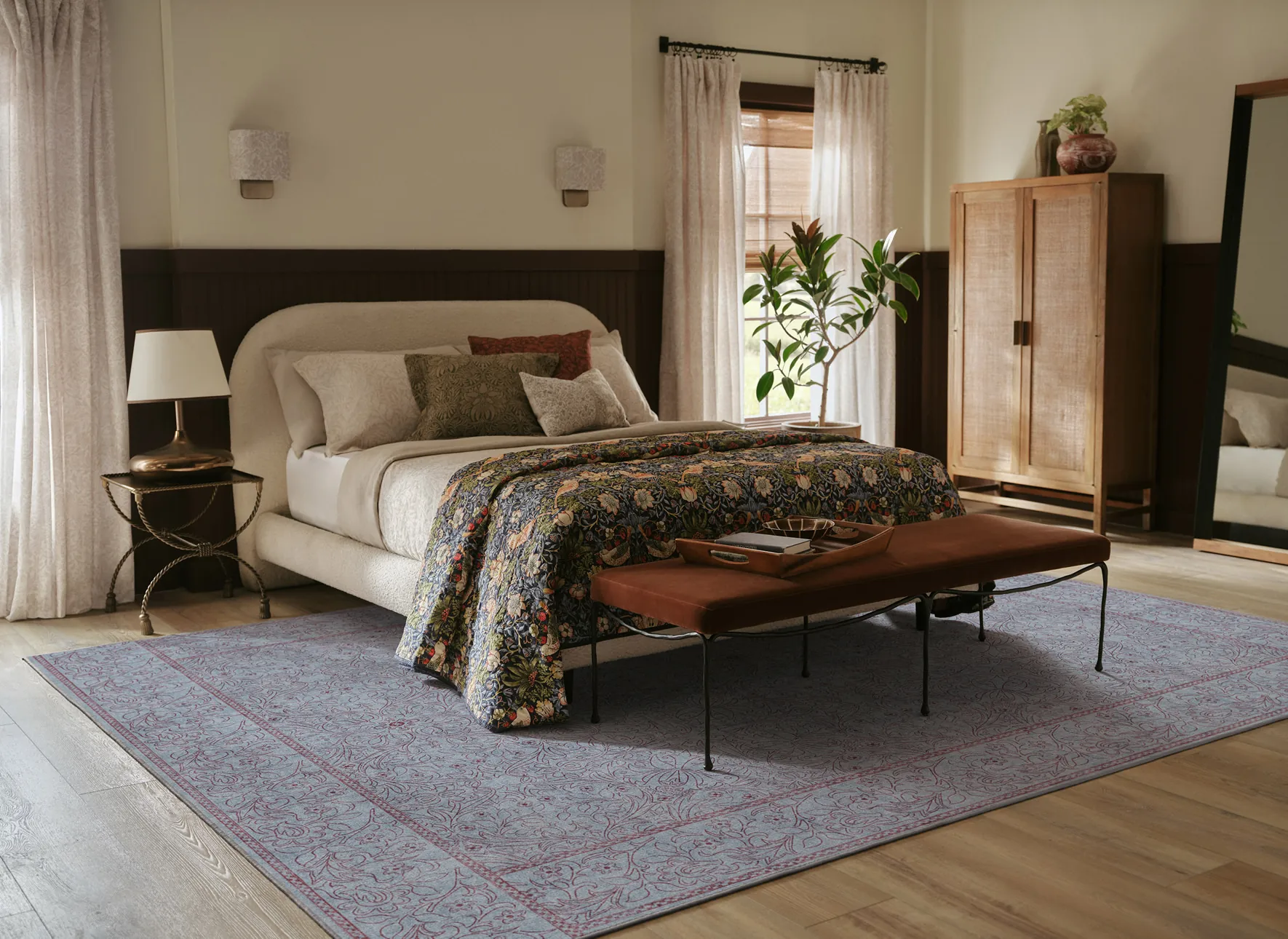
Ruggable x Morris & Co. Unfinished Works collection. Image: Ruggable; used for editorial coverage.
An incomplete embroidery sketch attributed to William Morris is now a 7 mm polyester rug with a waterproof barrier and built-in nonslip backing. That sentence contains almost the entire argument of the new Ruggable x Morris & Co. x The Huntington collection.
The historical claim is unusually substantial. Morris & Co. says its London studio worked from unfinished drawings by Morris and members of his studio that had remained in The Huntington’s archive, completing the motifs by hand and developing them into 26 new wallpaper and fabric designs. Ruggable then translated part of that work into machine-washable rugs and doormats.
This is not a simple reissue of Strawberry Thief or Willow Bough. It is a contemporary design team finishing work that the original designers left unresolved, then moving it onto a product system built for spills, pets, and washing machines.
The collection deserves attention for that process. Whether it deserves your floor depends on a more ordinary question: do the pattern, construction, and care routine suit the way you actually live?
What the collaboration actually created
The source collection, called The Unfinished Works, began with incomplete archival material attributed to William Morris and his studio, including work connected to John Henry Dearle. Morris & Co. describes the result as 26 new designs across wallpaper, borders, friezes, stripes, woven fabrics, damasks, and embroidery.
Ruggable’s edit turns those patterns into washable floor coverings. The US collection page currently lists indoor rugs from 2 x 3 feet to 10 x 14 feet, plus runners and two doormat sizes. Named designs include Chamomile, Daisy & Oak, Cornflower, Lent Lily, Hanover Check, Walthamstow, Woodbell & Anemone, Wild Tulip & Vine, and Oak & Blossom.
That distinction matters because the phrase “new William Morris designs” can blur authorship. Morris and his studio made the surviving drawings. The Huntington preserved them. Morris & Co.’s current designers interpreted missing parts, checked them against the company’s wider archive, repainted motifs, developed repeats, and chose contemporary colorways. Ruggable adapted selected results to its own rug constructions.
The archive supplied the beginning. The finished products are 2026 collaborations.
Why this is more interesting than another heritage reissue
Most heritage collections work by moving a familiar pattern onto a new object. Recognition does the selling. A shopper already knows the curling leaves of Willow Bough or the birds in Strawberry Thief, so a cushion, mug, or rug can borrow the authority of the original without asking much from the new design team.
The Unfinished Works had no complete pattern to reproduce. Morris & Co.’s designers had to decide how a stem continued, how a motif repeated, which gaps were intentional, and where the original hand stopped. Claire Vallis, the brand’s design director, said the team used graphite drawings, marginal notes, and the company’s archive to guide that work before repainting motifs by hand.
That is the collection’s non-interchangeable discovery. The value is not that an old pattern has returned. It is that the visible handoff between archive and present-day studio gives us a rare look at how a heritage brand decides what counts as continuity.
It also creates a useful limit. These designs should not be treated as newly discovered finished works by Morris. They are careful completions made after his lifetime. That does not make them less legitimate, but it does make the modern designers part of the authorship.
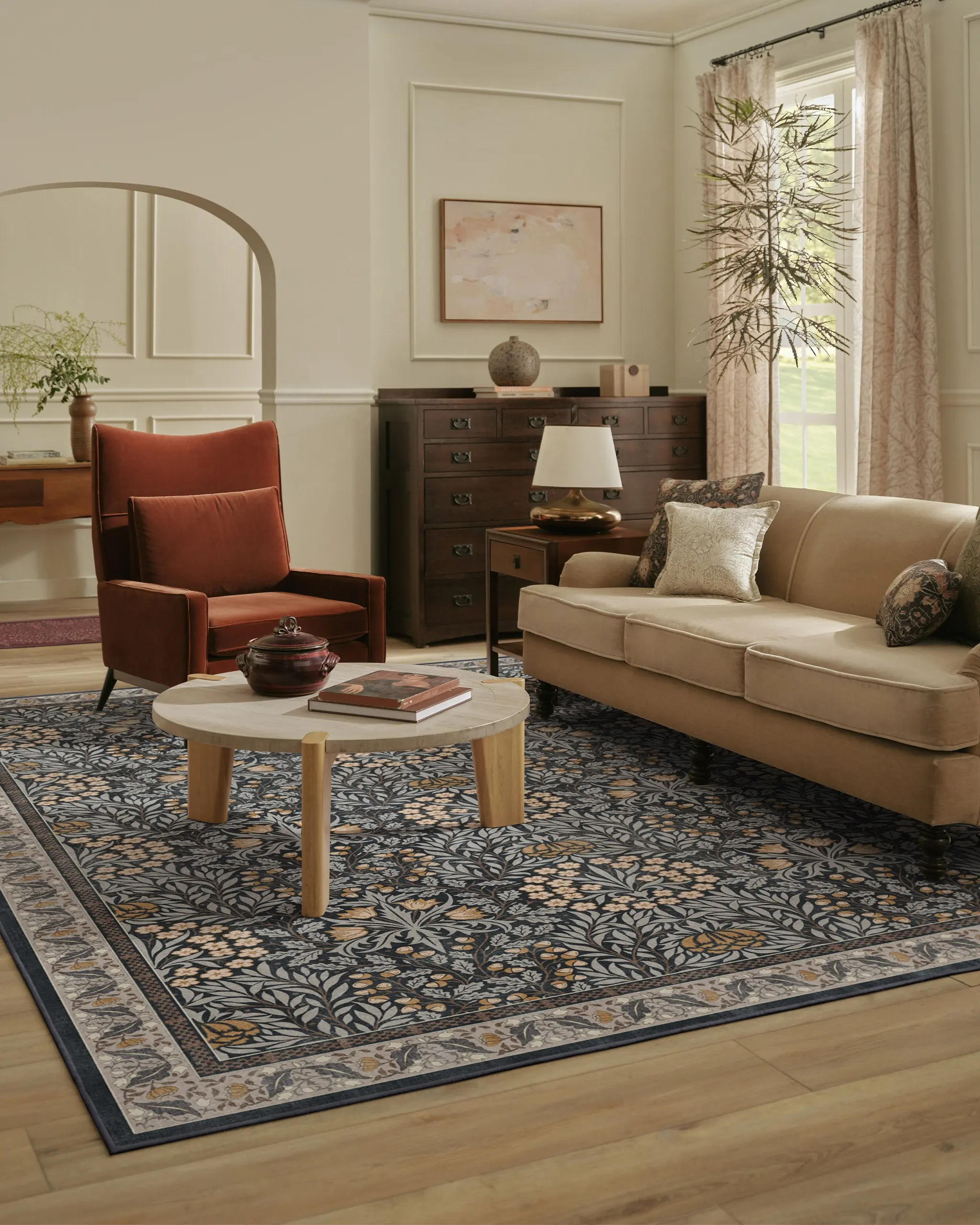
The Morris question: can a polyester rug carry an Arts and Crafts idea?
The material contradiction is hard to ignore. The Victoria and Albert Museum describes Morris as a critic of industrial production who cared about useful objects, quality making, and the maker’s connection to the work. Ruggable’s current tufted Chamomile rug uses a 100 percent polyester top, a waterproof barrier, and a built-in nonslip backing.
Calling that either a betrayal or a perfect update would be too easy.
Morris was not categorically opposed to machines. His sharper objection was to production systems that separated people from the thing they made and reduced quality in the process. The new collection begins with skilled archival interpretation and hand-painted development, then enters mass manufacture as a synthetic household product. Both facts belong in the same description.
Polyester changes the object. It allows a detailed print, stain resistance, lower-maintenance care, and a rug light enough to wash. It does not provide the material depth, repair path, or aging behavior of a hand-knotted wool rug. One is not a cheaper version of the other. They solve different household problems.
The useful comparison is not “authentic Morris” versus “fake Morris.” It is a choice between visual and archival access on one side, and natural material, repairability, and long service on the other.
What machine-washable really means
Ruggable sells more than one construction, and the care routine changes with it. The brand’s two-piece system uses a removable cover attached to a separate pad. Only the cover goes into the washing machine. Its All-in-One rugs have a nonslip backing built into the rug, so the entire piece is washed.
That convenience has conditions:
| Claim | What the care instructions add |
|---|---|
| Machine-washable | Use cold water, a delicate cycle, and mild bleach-free detergent |
| Easy to dry | Use low heat and confirm the pile and backing are fully dry before the rug returns to the floor |
| Suitable for large rooms | Some larger sizes may require a commercial washer rather than a standard home machine |
| Easy to vacuum | Ruggable recommends low suction and warns against harsh rotating brushes |
| Nonslip system | Two-piece covers must be used with the matching Ruggable pad; the pad itself is not machine-washable |
There is another practical point that product photography cannot show. An 8 x 10-foot or 9 x 12-foot washable rug still has to be lifted, carried, fitted into a machine, dried fully, and put back down. Washability removes professional cleaning from some spills, but it does not make a large rug weightless.
I reviewed the collection pages, product specifications, and care instructions. I did not handle, wash, or durability-test one of these rugs. This is a materials-and-use assessment, not a long-term product test.
Four patterns that make sense in different rooms
The collection is strongest when the pattern has a specific job. Treating every design as interchangeable “heritage style” misses the differences in scale, contrast, and visual weight.
| Design | What it does | Best setting | Skip when |
|---|---|---|---|
| Chamomile Burgundy | Builds a dense, low-contrast field from an embroidery-derived floral repeat | A living room or bedroom with plain upholstery and warm wood | The room is dark, small, and already carries several detailed textiles |
| Daisy & Oak Charcoal | Uses pale botanical structure against a deeper ground | A dining room where it can connect mixed wood tones | Pet hair, lint, or every crumb on a dark field will bother you |
| Hanover Check Natural | Translates the archive into a quieter geometric rhythm | A modern room that needs pattern without a full floral statement | You want the collection specifically for Morris’s botanical language |
| Walthamstow Slate Blue & Burgundy | Uses cooler blue as the field and burgundy as controlled linework | A bedroom, library, or calm living room with one repeated burgundy accent | The surrounding room is already cool gray and needs warmth rather than more blue |
My strongest pick is Hanover Check for a contemporary room because it carries the collection’s archival story without requiring the rest of the furniture to become historical. Chamomile Burgundy is the more expressive choice. Give it space, plain upholstery, and enough daylight to keep the repeat legible.
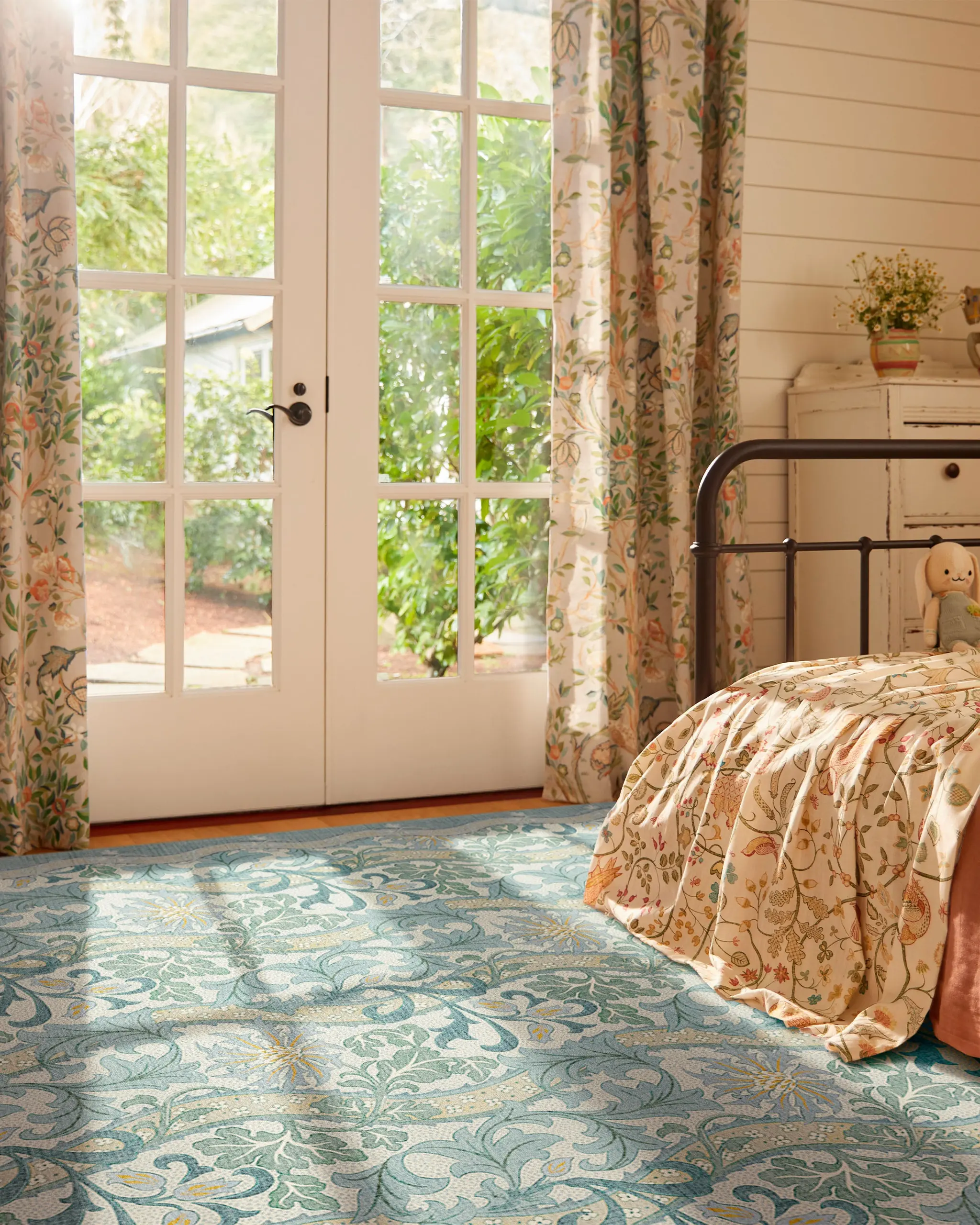
How to use a Morris pattern without turning the room into a set
A detailed rug already performs the work of color, rhythm, and ornament. The room does not need to repeat all three elsewhere.
Start with placement. A bedside runner or smaller rug can introduce a dense pattern without asking it to organize the entire room. Our bedside rug placement guide explains where the edges should land so the rug feels connected to the bed rather than stranded beside it.
For a living room, let the largest furniture pieces stay quieter than the floor. Solid upholstery, visible wood grain, and one repeated color are enough. The advice in our boho living room guide applies even if your room is not bohemian: collected pattern needs hierarchy or it becomes clutter.
Then check the repeat from the distance at which you will actually see it. A motif that looks delicate in a product close-up may merge into a single dark field from the doorway. Order a sample if the option is available, place it under daytime and evening light, and compare it with the sofa fabric and floor finish at the same time.
Do not add matching Morris cushions, curtains, wallpaper, and a framed textile because the rug worked. If the pattern makes you want a vertical version, a textile displayed as art is a better second move than repeating the same motif on every soft surface. Our guide to hanging a rug on the wall covers the support and proportion questions that keep that move deliberate.
Who this collection is for
This collaboration makes sense for a household that wants strong historical pattern but cannot treat a rug as a protected object. Children, pets, dining spills, and entryway dirt are legitimate design conditions. A rug that can be cleaned at home may be used in places where a delicate or professionally cleaned textile would create constant low-level anxiety.
It also suits someone who likes Morris but does not want the most recognizable archive motifs. The patterns carry the design language without repeating the same few images seen across wallpaper, notebooks, bedding, and museum-shop products.
I would skip it if natural fiber, repairability, and long material aging are the main reasons you want an Arts and Crafts rug. A printed polyester surface and a wool pile are different experiences underfoot and different propositions over time. I would also skip a large size if the rug will not fit the machine you can realistically use.
The verdict
The best part of the Ruggable x Morris & Co. x The Huntington collection is the part no washing machine can explain: current designers took incomplete historical work seriously enough to make their own decisions visible.
The rugs are not museum reproductions, and they are not substitutes for hand-knotted wool. They are contemporary, synthetic, washable products carrying patterns completed from an unusual archive. That is a more interesting claim than “heritage meets modern living,” and a more honest reason to consider one.
Choose the collection for the pattern and the care system you can actually manage. Choose a different rug if you want natural material, deep pile, or repairable construction. The archive gives these pieces their meaning. Daily use decides whether one earns the floor.











 Blankets and Throws
 Home Accessories
 Furniture
 Rugs
Rugs Cushions
 Kitchen
 Cutlery and Dinnerware
 Drinkware
 Table Mats and Coasters
 Dining Accessories
 Tablecloths and Napkins
 Decorative Items
 Vases and Planters
 Wall Decor
 Bathroom Accessories
 Bathroom Storage
 Bath and Shower Mats
 Towels